




Table of Contents Show
🇨🇦 OFFICIAL COMPENSATION UPDATE: CAF PAY 2025
Effective Date: April 1, 2025
Key Salary Adjustments:
- Entry-Level (PI 1): ~20% Increase ($52,044 starting)
- LCol and Below: ~13% Increase
- Colonel and Above: ~8% Increase
Retroactive Pay: Members received back-pay for April–October in their mid-November 2025 deposits.
New Longevity Bonus: Annual Military Service Pay lump sums (up to $6,000) now reward years of service.
On January 20, 2026, members and stakeholders of the Canadian Armed Forces (CAF) continue to assess the impact of a landmark compensation initiative introduced in 2025.
In a Government of Canada announcement on August 8, 2025, were confirmed for CAF personnel, retroactive to April 1, 2025, with some junior ranks seeing increases as high as 20% accompanied by enhancements to benefits such as housing differentials and separation support for members posted away from family.
According to the official Government of Canada pay and benefits page, the changes stem from a modernization of the Military Factor, the component of military pay designed to compensate service members for the unique demands of military life.
What Were the Core Pay Raise Changes for CAF Members in 2025?
The CAF pay raise in 2025 was one of the most substantial compensation adjustments in recent Canadian military history. It was designed to support both the recruitment of new personnel and the retention of experienced members amid evolving defence priorities.
The Government of Canada describes the Military Factor adjustment as a pensionable wage increase that reflects the demanding nature of military service, including frequent deployments, unpredictable schedules, and personal sacrifice.
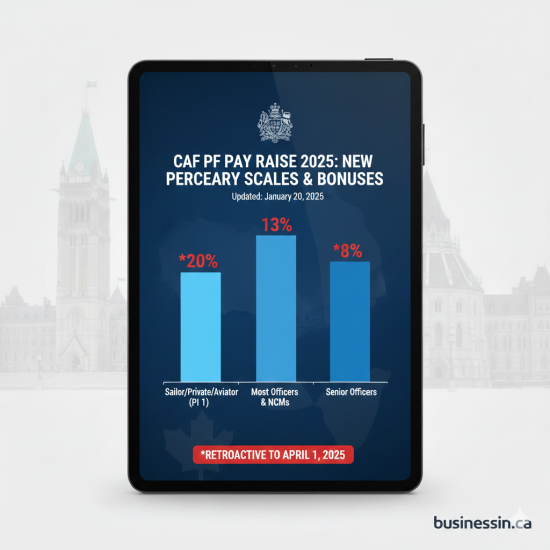
Here is a clear compensation breakdown:
| Rank Group | Approximate Pay Raise (Regular Force) | Scope Covered |
| Sailor/Private/Aviator, Pay Increment 1 | ~20 % | Entry‑level Regular Force members |
| Sailor/Private/Aviator, Pay Increment 2 to Lieutenant‑Colonel | ~13 % | Most non‑commissioned & general service officers; pilots; medical, dental and legal officers |
| Captain(Navy)/Colonel & above | ~8 % | Senior officers |
Members began to see their new pay rates and receive retroactive payments in their mid‑November 2025 paycheques once implementation progressed.
This pay raise applies to both Regular Force and Reserve Force members, including the Canadian Rangers and cadet organization personnel.
Impact Analysis: What This Means for Your Paycheque?
To understand how these changes look in practice, here is an estimated calculation for an entry-level member:
- Rank: Sailor 3rd Class / Private / Aviator (Pay Increment 1)
- Old Annual Salary (Approx): $43,368
- New Annual Salary (2025): $52,044
- Total Annual Increase: +$8,676
For a Captain at Pay Increment 1, the 13% increase represents a jump from approximately $92,900 to $104,977, pushing many general service officers into a higher six-figure pay bracket for the first time.
New Military Service Pay & Recruitment Bonuses
In addition to the monthly salary increases, the 2025 modernization package introduced a brand-new Military Service Pay. This is an annual, pensionable lump-sum payment designed to reward longevity in the forces.
Military Service Pay Table (Annual Lump Sum)
This payment is based on your total years of service and is tied to your enrolment date:
| Years of Service | Regular Force (Lump Sum) | Reserve Force (Lump Sum) |
| 5–10 Years | $2,000 | $400 |
| 11–15 Years | $3,500 | $700 |
| 16–20 Years | $5,000 | $1,000 |
| 21+ Years | $6,000 | $1,200 |
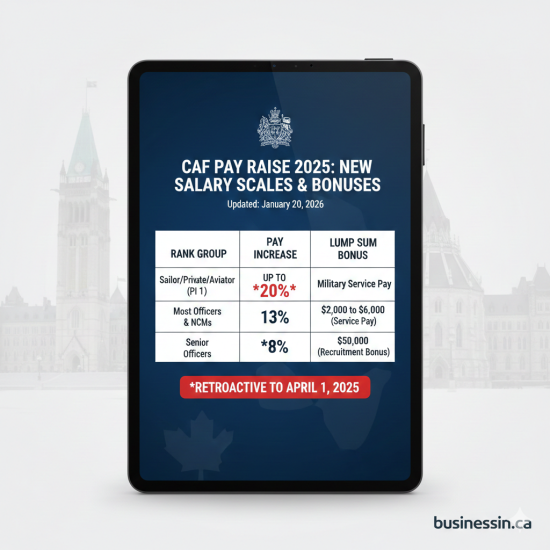
$50,000 Recruitment & Retention Allowances
To address critical shortages in “stressed occupations” (such as vehicle technicians, dental technicians, and ship engineers), the CAF has implemented a massive $50,000 allowance for new members in these trades.
The payout schedule is as follows:
- $10,000 upon completion of Basic Training (BMQ).
- $20,000 once fully qualified in your specific trade.
- $20,000 upon completion of your first contract (when signing on for another term).
Why Did the Government Implement the 2025 CAF Pay Raise?
The federal government’s decision to enhance CAF compensation in 2025 was anchored in longer‑term objectives around recruitment and retention, as well as recognition of the distinct challenges military service entails.
In announcing the measures, the Government highlighted that:
- CAF compensation required modernization to better reflect the difficulty and unpredictability of military life.
- The pay adjustments are comparative with civilian public service benchmarks but include premiums for service obligations that public servants do not face.
The Prime Minister described the initiative as part of broader defence investments aligned with Canada’s strategic vision for its military.
When speaking informally about the changes, a senior non‑commissioned member shared: “It isn’t just about a bigger number on a pay stu, this increase feels like formal recognition of what we give up each day.” This reflects the sentiment among many members who see the raise as overdue, though not the sole remedy for broader challenges.
How Were Members Paid Retroactively, and When Did Adjustments Apply?

An important aspect of the 2025 CAF pay raise was its retroactive application to April 1, 2025. That means CAF members received back pay covering the months between April and when the new pay rates took effect.
Official communications confirmed that members began receiving these retroactive funds in their mid‑November 2025 pay deposits as part of the phased rollout.
These retroactive payments were significant for many members, particularly those with several months of service during the retroactive period. This approach ensured that serving members did not forfeit compensation during the period required to update pay systems and procedures.
A Reserve Force aviator commented, “Seeing that retroactive payment in November was a tangible moment, it proved this wasn’t just a promise but something real.” Such feedback illustrates how the timing and delivery of back pay matter deeply to members and their financial planning.
What Is the Military Factor and How Was It Modernized?
The Military Factor is a percentage applied on top of base military salaries to account for the inherent responsibilities and constraints associated with military duties. It exists because CAF members do not unionize, and their base pay is otherwise benchmarked to civilian federal public service pay scales.
Modernizing this factor was essential to:
- Acknowledge non‑monetary demands such as around‑the‑clock availability and frequent compulsory moves.
- Offer a more competitive and structured compensation framework in light of rising civilian wages and living costs.
The updated Military Factor ensures that CAF compensation better matches members’ expectations and the realities of service in the 2020s.
How Did the 2025 Raise Interact With Housing and Separation Benefits?

The 2025 compensation changes were part of a broader Phase One initiative that also included adjustments to the Canadian Forces Housing Differential (CFHD) and enhancements to Separation Expense policies.
Canadian Forces Housing Differential (CFHD)
The CFHD helps offset local housing costs when members are posted away from their principal residences. Upon implementation of the pay raise, CFHD salary bands were updated effective August 6, 2025, to ensure that increases in base pay did not unintentionally reduce housing support.
However, as part of the annual review process, CFHD rates are set to be recalculated on July 1, 2026, using the new salary levels, which, depending on housing market conditions, may affect individual entitlement amounts.
Separation Expense (SE) Enhancements
Effective November 1, 2025, the SE policy was modernized to better support members.
Key improvements include:
- Daily Food Reimbursement: Available when standard ration support is not provided.
- Monthly Transportation: Financial assistance to help members travel back to their primary residence.
- Miscellaneous Allowance: A new monthly payment to cover the “hidden costs” of living away from home.
What Has Been the Broader Reaction to the Pay Raise?
Responses to the 2025 CAF pay raise, both within and outside the Forces, have been largely positive, though commentators stress that compensation is just one piece of a more complex challenge.
Members have welcomed the increased take‑home pay and retroactive amounts as overdue enhancements that acknowledge service realities.
At the same time, independent defence analysts emphasize that while pay raise initiatives are critical, they are not a “silver bullet” for recruitment and retention challenges without concurrently addressing housing availability, family‑oriented benefits, and career development pathways.
What Should CAF Members Expect Going Forward?
The 2025 compensation updates represent just the first phase of a longer agenda to modernize military pay and benefits. Members are advised to monitor official Government of Canada pay and benefits pages, such as Military pay – Canada.ca, for the latest schedules and guidance from the Department of National Defence.
Future reviews may address additional compensation categories as well as broader quality‑of‑life supports tied to housing, child care, and career progression.
Summary: What the CAF Pay Raise 2025 Means for Military Members?
The CAF pay raise implemented in 2025 marked a significant enhancement to military compensation, with up to 20 % increases for junior ranks, 13 % for most officers and non‑commissioned members, and 8 % for senior officers, all retroactive to April 1, 2025.
Coupled with housing differential adjustments and separation expense enhancements, the changes aim to create a more competitive, responsive pay and benefits structure for CAF members and their families, acknowledging the unique challenges of military service in Canada today.
FAQs About the 2025 CAF Pay Raise
Is the CAF pay raise automatic for all CAF members?
Yes, eligible serving members automatically received updated pay rates and retroactive back‑pay.
Does the raise apply to Reserve Force members?
Yes. Reserve Force members receive increases broadly in line with Regular Force percentages.
Will this raise affect pension calculations?
Yes, because the increases are pensionable, they can influence future pension entitlements.
Did the CFHD changes happen at the same time?
CFHD adjustments were scheduled to align with the updated pay structure and took effect in mid‑2025.
Does the separation expense support help families financially?
Yes, the enhanced separation expense policy now includes food, travel, and miscellaneous allowances.
Are these pay increases tied to inflation?
The increases aim to make CAF pay more competitive and offset cost‑of‑living pressures, not strictly match inflation rates.
Where can members find the official updated pay scales?
Members should consult the Government of Canada’s official Military Pay pages for detailed tables and updated rates.