




Table of Contents Show
Ontario vehicle registration is the process of officially recording a vehicle and its owner with the province.
In 2026, most vehicle registrations are handled through ServiceOntario, where an owner can receive a vehicle permit and, where required, licence plates.
The process varies depending on whether the vehicle is new, used or being brought into Ontario from another province or country.
Insurance is generally required before registration, while used vehicles may also need documents such as a Used Vehicle Information Package and Safety Standards Certificate.
Ontario has also significantly changed its licence plate system in recent years, including eliminating standard passenger plate renewal fees and introducing automatic renewals for eligible vehicles.
How Does Vehicle Registration Work In Ontario In 2026?
Registering a vehicle establishes the registered owner in Ontario’s provincial system and allows the appropriate permit and licence plate to be issued.
When a new vehicle is purchased from an Ontario dealership, the dealer will normally complete the registration process for the buyer. If the dealer does not complete it, the owner must generally visit a ServiceOntario centre.
A privately purchased used vehicle works differently. The buyer must register the vehicle in their name within six days of the purchase.
Registration requires documents confirming the purchase, ownership, insurance and, where applicable, the vehicle’s roadworthiness.
It is also important to distinguish registration from licence plate renewal. Registering a vehicle generally happens when ownership is established or transferred. Licence plate renewal keeps the plate valid after registration.
Ontario’s vehicle system has become increasingly digital, but initial vehicle registration is still generally handled through a ServiceOntario location rather than being completed entirely online.
What Documents Are Mandatory For Ontario Vehicle Registration?
The documents needed depend on how the vehicle was obtained, but a person registering a vehicle will generally need to provide identification, proof of purchase and proof of insurance.
Common requirements include:
- Identification: An Ontario driver’s licence or another acceptable identity document showing the person’s legal name, date of birth and signature
- Proof Of Insurance: Coverage from an insurance provider licensed in Ontario
- Proof Of Purchase: A bill of sale, receipt or other acceptable purchase document
- Vehicle Permit: The original permit from the previous owner when registering a used vehicle
- Application For Transfer: The transfer section of the previous owner’s vehicle permit
- Used Vehicle Information Package: Required in many private used-vehicle transactions
- Safety Standards Certificate: Required where Ontario’s safety rules apply
- Odometer Information: Required for applicable used-vehicle transfers
Insurance should not be treated as an optional step. Ontario requires insurance before someone registers as the owner of a vehicle. The province requires at least $200,000 in third-party liability coverage.
Insurance costs can vary substantially by driver and vehicle, so buyers considering the overall expense of ownership may also want to understand how much car insurance costs in Ontario before completing a purchase.
What Does The Ontario Government Require Before A Vehicle Can Be Registered?
The government does not apply exactly the same requirements to every type of vehicle or transaction.
For a typical passenger vehicle, the owner must be able to prove their identity, ownership or purchase of the vehicle and valid Ontario insurance.
A Safety Standards Certificate may also be required before the vehicle can be registered as fit for road use.
Ontario says an SSC confirms that the vehicle met minimum safety requirements at the time of inspection. It should not be treated as a guarantee of the vehicle’s mechanical condition.
Private used-vehicle sales can also require a Used Vehicle Information Package. The package includes details such as:
- Vehicle Description
- Ontario Registration History
- Odometer Information
- Lien Information
- Average Wholesale Value
- Vehicle Status
- Bill Of Sale Section
The seller is normally legally required to provide the UVIP when selling a qualifying pre-owned vehicle privately in Ontario. It currently costs $20 when ordered through the province.
Private vehicle sales involve additional steps because the buyer and seller must complete the required ownership documents, meet applicable safety requirements and deal with any taxes due.
Understanding how to transfer vehicle ownership in Ontario can help both parties complete the transaction correctly.
How To Register A Vehicle In Ontario?
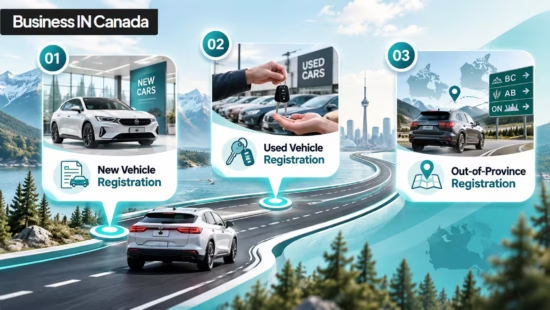
The registration steps depend mainly on whether the vehicle is new, used or from outside Ontario.
Registering A New Vehicle
A dealership will usually register a brand-new vehicle for its purchaser. This means the buyer normally does not need to complete a separate registration visit.
If the dealership does not process the registration, the buyer will need to attend a ServiceOntario centre with the required identity, purchase and insurance documents.
ServiceOntario must also confirm sales involving certain new vehicles purchased from dealerships outside Ontario before those vehicles can be registered.
Registering A Used Vehicle
A buyer purchasing a used vehicle privately must normally register it within six days.
The buyer should bring:
- Proof Of Insurance
- Ontario Driver’s Licence Or Accepted Identification
- Used Vehicle Information Package
- Bill Of Sale
- Safety Standards Certificate If Required
- Original Vehicle Permit With The Transfer Section Completed
- Odometer Information
The seller normally keeps their licence plates because Ontario plates generally stay with the plate holder rather than automatically transferring with the vehicle.
Registering An Out-Of-Province Vehicle
Vehicles brought to Ontario from another province, territory or country require additional steps.
The owner generally needs to meet Ontario’s standard registration requirements and provide ownership documents from the previous jurisdiction.
Vehicles entering Ontario from outside Canada can require additional import documentation, including customs clearance and Vehicle Import Form 1 where applicable.
A safety inspection may also be required before the vehicle can obtain Ontario registration for road use.
How Long Do You Have To Register A Vehicle In Ontario?
The deadline depends on the situation.
| Situation | General Requirement |
| Used vehicle purchased privately in Ontario | Register within 6 days of purchase |
| New vehicle from dealership | Normally registered by dealer |
| Becoming an Ontario resident with an existing out-of-province vehicle | Ontario law provides a 30-day registration exemption where the previous registration remains compliant |
| Change of address | Update the vehicle permit within 6 days |
| Change to vehicle information | Update the permit within 6 days |
Ontario’s Highway Traffic Act provides a new Ontario resident with a 30-day exemption from Ontario registration requirements if the person continues to comply with the registration rules of the jurisdiction they previously lived in and continues displaying the valid registration number.
This should not be confused with Ontario driver’s licence rules, which may operate on different time limits.
How Have Ontario Vehicle Registration Rules Changed Over The Years?
Ontario’s registration and licence plate system has changed substantially in recent years.
Before March 2022
Passenger vehicle owners generally paid an annual licence plate validation fee. The fee was typically $120 in Southern Ontario and $60 in Northern Ontario.
Vehicles also used physical licence plate validation stickers.
March 2022
Ontario eliminated licence plate renewal fees and stickers for eligible passenger vehicles, light commercial vehicles, motorcycles and mopeds.
For a regular passenger vehicle in Southern Ontario, the annual validation fee fell from $120 to $0.
However, eliminating the fee did not originally eliminate the need to renew the plate.
July 2024
Ontario introduced automatic licence plate renewal for eligible passenger vehicles, light-duty vehicles, motorcycles and mopeds.
The automatic system came into effect on July 1, 2024. Eligible plates renew approximately 90 days before expiry when the owner has valid insurance and no outstanding qualifying fines or tolls.
By 2026
Automatic renewal remains in place for eligible vehicle types. Owners whose plates successfully renew:
- Do Not Pay A Standard Renewal Fee
- Do Not Receive A Licence Plate Sticker
- Do Not Need To Complete A Normal Manual Renewal
- Receive One Year Of Plate Validity
- Must Continue To Have Valid Insurance
- Must Clear Applicable Outstanding Fines, Fees And Tolls
The changes mean Ontario’s current registration system is quite different from the older sticker-based process.
Articles that still tell passenger vehicle owners to pay $120 each year or attach a new sticker are no longer describing the standard 2026 system correctly.
How Much Does It Cost To Register A Vehicle In Ontario In 2026?
There is no single fee covering every type of Ontario vehicle registration.
Current Ontario fee information lists a vehicle permit for a motor vehicle or motorcycle at $32. Other costs depend on whether the applicant needs licence plates, a temporary permit, a replacement or another registration product.
Some current listed charges include:
| Vehicle Service | Current Listed Fee |
| Vehicle Permit For Motor Vehicle Or Motorcycle | $32 |
| Trailer Plate, Permit And Validation | $72 |
| Off-Road Vehicle Permit And Number Plate | $38 |
| Motorized Snow Vehicle Registration | $33 |
| Passenger 10-Day Trip Permit | $23.50 |
| Standard Eligible Passenger Vehicle Plate Renewal | $0 |
Licence plates and special plate products can have separate charges.
Used vehicles can also create a much larger tax cost than the basic permit fee.
In a private sale, Ontario generally collects Retail Sales Tax when the buyer registers the vehicle. The amount can depend on the purchase price and the vehicle’s wholesale value.
Does The Cost Of Vehicle Registration Increase Every Year?
No. Ontario vehicle registration costs do not automatically rise every year across every registration service.
Fees can change when Ontario updates its fee schedule, but different vehicle products are treated differently. The government states that driver and vehicle fees are subject to change and posts current charges through ServiceOntario.
In fact, the biggest recent change for ordinary passenger vehicles moved costs in the opposite direction.
The standard passenger vehicle licence plate validation fee dropped to $0 in March 2022 and remains $0 for eligible vehicles in 2026.
Drivers should therefore distinguish between:
- Initial Registration Costs
- Vehicle Permit Fees
- Licence Plate Costs
- Replacement Fees
- Used-Vehicle Taxes
- Commercial Vehicle Fees
- Annual Plate Renewal Fees
The amount payable will depend on the transaction rather than simply increasing once each year.
Does Ontario Vehicle Registration Automatically Renew?
Vehicle registration itself should not be confused with licence plate renewal.
Ontario automatically renews eligible licence plates approximately 90 days before they expire.
Automatic renewal currently applies to eligible:
- Passenger Vehicles
- Light Commercial Vehicles Under 3,000 kg
- Motorcycles
- Mopeds
For automatic renewal to take place, the owner must generally have valid vehicle insurance and no applicable outstanding fines, fees or tolls.
Commercial and business vehicles, motorhomes, buses, school buses, certain older vehicles and snowmobiles are among the types that may still require manual renewal.
If the plate cannot automatically renew, ServiceOntario can notify the owner so the issue can be resolved. Drivers signed up for digital reminders may receive notifications before the expiry date.
Outstanding fines can therefore affect more than a driver’s immediate finances. Drivers unsure whether they have unresolved offences can learn more about checking traffic tickets online in Ontario.
What Rules Apply When Registering A Used Vehicle In Ontario?
Used vehicles have some of Ontario’s most detailed registration requirements.
A buyer must normally register the vehicle in their name within six days of the purchase.
The buyer should make sure the seller provides:
- Vehicle Portion Of The Permit
- Completed Application For Transfer
- Used Vehicle Information Package
- Signed And Dated Bill Of Sale
- Safety Standards Certificate Where Required
The UVIP can help the buyer identify previous registration information, liens, the vehicle’s average wholesale value and recorded vehicle status.
A Safety Standards Certificate may be needed for the vehicle to be registered as fit and operated on public roads.
A vehicle can sometimes be transferred without an SSC but may be recorded as unfit, meaning additional requirements must be completed before it can legally be driven.
Drivers should also physically compare the Vehicle Identification Number on the vehicle with the documentation before completing the purchase.
How Do New Ontario Residents Register An Out-Of-Province Vehicle?
A new Ontario resident who brings a vehicle from another province or territory generally needs to register it through ServiceOntario.
Ontario law provides a 30-day period after someone becomes an Ontario resident during which the vehicle may remain exempt from Ontario registration requirements, provided the previous jurisdiction’s registration requirements continue to be satisfied.
Depending on where the vehicle comes from, registration can involve:
- Proof Of Identity
- Existing Vehicle Ownership
- Ontario Vehicle Insurance
- Safety Standards Certificate
- Vehicle Identification Information
- Applicable Registration Fees
- Import Documentation If Coming From Outside Canada
Vehicles imported from another country can have additional federal requirements. Ontario says vehicles from outside Canada may require customs clearance documentation, including Vehicle Import Form 1.
New residents should also remember that changing a vehicle registration and obtaining an Ontario driver’s licence are separate processes with their own deadlines.
When Must You Update Your Ontario Vehicle Permit?

Ontario requires vehicle permit information to remain current.
A person must generally update their driver’s licence and vehicle permit within six days of changing their address.
Permit information may also need updating if relevant vehicle information changes.
For example, owners may need ServiceOntario when dealing with:
- A New Residential Address
- Incorrect Permit Information
- Changes To Vehicle Details
- Ownership Transfers
- Replacement Of A Lost Or Damaged Permit
Someone who has recently moved can follow the process for a ServiceOntario change of address to make sure their vehicle and driver records are updated correctly.
Keeping the address current is particularly important under automatic plate renewal because ServiceOntario may send a letter if a plate cannot automatically renew.
What Happens If Your Vehicle Registration Or Permit Is Lost?
If the green Ontario vehicle permit is lost, stolen or damaged, the owner should arrange a replacement through ServiceOntario.
A vehicle permit is separate from a driver’s licence and licence plate, so the replacement procedure depends on exactly what has been lost.
If the licence plate itself has been lost or stolen, the owner should deal with the plate rather than simply requesting another vehicle permit.
Owners should keep their registration documents secure and avoid leaving unnecessary ownership information exposed inside an unattended vehicle.
The permit is important when transferring ownership, changing vehicle details and completing other ServiceOntario transactions, so a missing permit should be replaced rather than ignored.
Ontario Vehicle Registration FAQs
Is Vehicle Registration Mandatory In Ontario?
Yes. A vehicle generally needs to be properly registered and permitted before it can legally be operated on Ontario roads, subject to specific exemptions such as certain temporary provisions for new residents.
Can You Register A Vehicle Without Insurance In Ontario?
Normally, no. Ontario requires proof of insurance from an insurer licensed in the province when registering a vehicle.
How Long Do You Have To Register A Used Vehicle In Ontario?
A buyer generally has six days from the date of purchase to register a privately purchased used vehicle in their name.
Is Ontario Vehicle Registration $120 Per Year?
No. The old $120 Southern Ontario passenger vehicle validation fee was eliminated in March 2022. Eligible passenger plate renewals currently cost $0. Registration-related permit, plate, tax and replacement charges can still apply.
Do Ontario Licence Plates Still Need Stickers In 2026?
Eligible passenger vehicles, light commercial vehicles, motorcycles and mopeds that use the current automatic renewal system do not receive annual licence plate stickers.
How Much Is An Ontario Vehicle Permit?
Ontario currently lists the vehicle permit fee for a motor vehicle or motorcycle at $32. Fees can change, so drivers should confirm the current ServiceOntario schedule before completing a transaction.
Does Ontario Automatically Renew Licence Plates?
Yes, for eligible passenger vehicles, motorcycles, mopeds and light commercial vehicles under 3,000 kg. The owner must have valid insurance and no outstanding qualifying fines or tolls.
Do New Ontario Residents Have To Change Their Vehicle Registration?
Yes. Ontario law generally provides a new resident with a 30-day exemption before Ontario vehicle registration is required, provided the vehicle remains properly registered under the previous jurisdiction’s rules during that period.






Comments 1