



Table of Contents Show
Last Updated: 14.10.2026
A B.C. Class 3 licence is a commercial driver’s licence designed mainly for people who need to operate heavy straight trucks and certain specialized commercial vehicles in British Columbia.
It allows qualified drivers to operate trucks with more than two axles, including many dump trucks, large tow trucks and other heavy single-unit vehicles.
It is different from a standard Class 5 licence and does not give the same privileges as a Class 1 licence.
Class 1 is generally required for tractor-trailer combinations, while Class 3 is aimed more at heavy straight-truck operations.
In 2026, applicants must meet ICBC’s commercial licensing requirements, obtain a commercial learner’s licence, complete the required testing and meet medical standards before receiving full Class 3 privileges.
The minimum age for a Class 3 licence is 18.
Why Was The B.C. Class 3 Licence Introduced?
The Class 3 licence exists because operating a heavy commercial truck requires considerably more knowledge and skill than driving an ordinary passenger vehicle.
Large trucks have different braking distances, turning characteristics, blind spots, weight distribution and inspection requirements.
Commercial drivers also have additional responsibilities for vehicle condition and road safety.
The Class 3 category therefore separates heavy straight-truck drivers from ordinary Class 5 motorists while also distinguishing them from Class 1 tractor-trailer drivers.
The licence system helps ensure drivers operating these vehicles understand areas such as:
- Vehicle Inspections
- Heavy-Vehicle Handling
- Safe Braking
- Turning And Clearance
- Commercial Road Rules
- Load And Vehicle Safety
- Air Brake Systems Where Applicable
This is particularly important because Class 3 vehicles are commonly used in construction, towing, municipal services, waste collection and other industries where trucks can be significantly larger and heavier than passenger vehicles.
What Is The B.C. Class 3 Licence Mainly Used For?
The Class 3 licence is mainly intended for people who operate heavy single-unit commercial trucks with more than two axles.
Common uses include driving:
- Dump Trucks
- Large Tow Trucks
- Concrete And Construction Trucks
- Water Trucks
- Vacuum Trucks
- Garbage And Recycling Trucks
- Certain Mobile Truck Cranes
- Other Multi-Axle Straight Trucks
It can be useful for people entering construction, municipal services, road maintenance, towing, waste management and other commercial driving occupations.
Drivers who are starting with an ordinary passenger licence may also benefit from understanding the broader B.C. driver’s licence system before moving into commercial licensing.
What New Rules Apply To The B.C. Class 3 Licence In 2026?
There has not been a complete replacement of the Class 3 licensing system in 2026.
The important point for applicants is to follow the current ICBC commercial-driver requirements rather than older information that may still appear online.
Current Class 3 rules include:
- Minimum Age Of 18 for Class 3 applicants
- Full-Privilege Licence Requirement before applying
- Acceptable Commercial Driving Record
- Commercial Knowledge Testing
- Road Signs Testing
- Medical Standards
- Vision Screening
- Pre-Trip Inspection Testing
- Commercial Road Testing
- Air Brake Requirements when driving air-brake-equipped vehicles
Applicants must generally have fewer than four penalty-point incidents during the previous two years and no driving-related criminal convictions during the previous three years.
Applicants who are exactly 18 years old also require consent from a parent or legal guardian when applying for a Class 3 licence.
Another important 2026 development in B.C. is the modernization of driver licensing.
Online knowledge testing launched in June 2026 for passenger vehicle and motorcycle classes, but ICBC’s online system currently applies to Classes 5 through 8 rather than replacing the commercial Class 3 licensing process.
B.C. is also changing its Graduated Licensing Program from October 19, 2026.
Those changes primarily concern the progression from Class 7 to Class 5 and do not eliminate the separate commercial requirements for obtaining Class 3 privileges.
What Vehicles Can You Drive With A Class 3 Licence In B.C.?
A Class 3 licence generally allows you to operate trucks with more than two axles, along with vehicles included in lower applicable licence classes.
Depending on the vehicle configuration, this may include:
- Dump Trucks
- Large Tow Trucks
- Garbage Trucks
- Heavy Utility Trucks
- Concrete Trucks
- Water Trucks
- Vacuum Trucks
- Mobile Truck Cranes
- Certain Construction Vehicles
- Class 5 Vehicles
The exact vehicle must still comply with any restrictions shown on the driver’s licence.
If the truck uses air brakes, the driver also needs the appropriate air brake endorsement before operating it on public roads.
What Vehicles Can You Not Drive With A Class 3 Licence?
A Class 3 licence does not give unlimited commercial-driving privileges.
It does not normally authorize you to drive vehicles that specifically require another licence class, including:
- Tractor-Trailer Combinations Requiring Class 1
- Passenger Buses Requiring Class 2
- Taxis Requiring Class 4
- Limousines Requiring Class 4
- Ambulances Requiring Class 4
- Motorcycles Without The Appropriate Motorcycle Licence
This distinction is important because older Class 3 information sometimes incorrectly suggests that buses and ambulances are automatically included.
Drivers should always check the class required for the exact vehicle and work being performed.
What Are The Eligibility Requirements For A B.C. Class 3 Licence In 2026?
Before applying, you need to satisfy ICBC’s commercial-driver requirements.
You generally need to:
- Be At Least 18 Years Old
- Hold A Full-Privilege Class 5 Or Class 6 Licence Or Equivalent
- Have An Acceptable Commercial Driving Record
- Meet Medical Standards
- Meet Vision Requirements
- Pass The Required Knowledge Tests
- Pass The Commercial Road Test
Your driving record must generally show fewer than four penalty-point incidents within the previous two years and no driving-related criminal convictions during the previous three years.
People who have moved to British Columbia from another province or country within the previous three years may also need to provide a three-year driving record from the previous jurisdiction.
How Do You Apply For A B.C. Class 3 Licence?
The process involves moving from eligibility and knowledge testing through to a commercial learner’s licence and then the full road test.
Step 1: Check Your Eligibility
Make sure you meet the age, licence, driving-record and medical requirements before beginning.
You must normally already hold a full-privilege Class 5 or Class 6 licence or an acceptable equivalent from another jurisdiction.
Step 2: Study For The Knowledge Tests
Applicants should study ICBC’s Driving Commercial Vehicles material.
The commercial guide covers topics such as:
- Commercial Vehicle Operation
- Vehicle Inspections
- Road Safety
- Braking
- Vehicle Control
- Commercial Driving Responsibilities
- Air Brakes Where Applicable
Commercial applicants also need knowledge of B.C. road signs.
Step 3: Pass The Knowledge And Road Signs Tests
Visit an ICBC driver licensing office and complete the required commercial knowledge testing.
ICBC will also check whether you meet the licensing requirements and conduct vision screening. Medical information that could affect your ability to drive may require further assessment.
Step 4: Get Your Class 3 Learner’s Licence
Once you meet the requirements and pass the necessary tests, you can receive a commercial learner’s licence.
A commercial learner’s licence is valid for one year. If it expires, it can be renewed by retaking and passing the knowledge test.
Step 5: Complete Air Brake Requirements If Required
If you intend to operate an air-brake-equipped truck, you need the appropriate air brake qualification.
Drivers generally need to complete approved air brake training or demonstrate qualifying experience, pass the knowledge test and satisfy the applicable pre-trip inspection requirements.
Step 6: Practise In A Suitable Class 3 Vehicle
Use your learner’s licence to build experience under appropriate supervision.
Focus on:
- Vehicle Control
- Backing
- Turning
- Lane Positioning
- Safe Following Distance
- Pre-Trip Inspections
- Braking
- Commercial Traffic Situations
Professional driver training is not the same as the Class 1 MELT requirement, but formal training can help applicants prepare for operating a heavy commercial vehicle safely.
Step 7: Pass The Pre-Trip Inspection And Road Test
When ready, book the commercial road test.
You must bring an appropriate vehicle for the licence class being tested.
The commercial test includes:
- Pre-Trip Inspection Test
- Air Brake Pre-Trip Test If Applicable
- On-Road Driving Test
Applicants for unrestricted Classes 1, 2, 3 and 4 also need to complete a written trip-inspection report.
Step 8: Complete Medical And Licensing Requirements
After passing, you must complete the remaining licensing and medical requirements.
Commercial drivers are subject to higher medical standards than ordinary passenger-vehicle drivers and may be required to submit medical examination reports periodically throughout their commercial driving career.
What Tests Do You Need To Pass For A Class 3 Licence?
Class 3 applicants go through several assessments rather than one simple driving test.
These can include:
- Commercial Knowledge Test
- Road Signs Test
- Vision Screening
- Air Brake Knowledge Test If Applicable
- Pre-Trip Inspection Test
- Air Brake Pre-Trip Inspection If Applicable
- Commercial Road Test
- Medical Examination Requirements
The road test evaluates whether you can safely operate a commercial vehicle in real traffic while demonstrating proper observation, control, positioning, braking and decision-making.
The pre-trip section is also important. The examiner expects you to demonstrate and explain how you would inspect important vehicle components before driving.
Do You Need An Air Brake Endorsement For A Class 3 Licence?
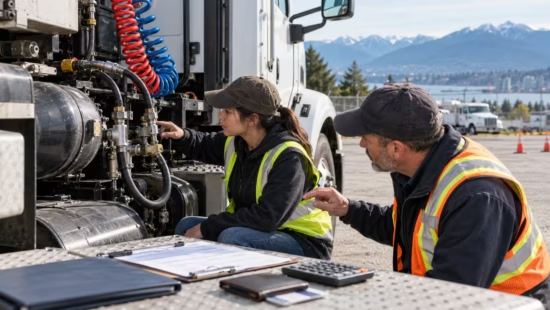
You need an air brake endorsement if the Class 3 vehicle you operate is equipped with air brakes and is being driven on public roads.
For a single-unit commercial vehicle, ICBC generally requires drivers to:
- Complete An Approved Air Brake Course Or Have Qualifying Experience
- Pass The Air Brake Knowledge Test
- Pass The Required Air Brake Pre-Trip Inspection
- Pay The Applicable Licensing Fees
An ICBC driver-certification air brake course includes seven hours of classroom theory and four hours of practical pre-trip inspection training.
Drivers who successfully complete the certification course do not normally have to complete the separate ICBC air brake pre-trip inspection test.
A standard air brake course contains seven hours of classroom theory, with separate testing requirements afterward.
How Much Does A B.C. Class 3 Licence Cost In 2026?
There is no single price that applies to every Class 3 applicant.
Your total cost can include:
- Commercial Knowledge Test Fees
- Learner’s Licence Fees
- Class 3 Road Test Fees
- Licence Issuance Fees
- Medical Processing Fees
- Doctor’s Examination Fees
- Air Brake Course Fees
- Professional Driver Training
- Road-Test Vehicle Rental
Professional instruction can make the overall cost considerably higher than ICBC’s basic licensing charges.
Applicants should therefore separate the government licensing cost from optional or required training costs when preparing a budget.
Medical examination charges can also vary because the doctor’s fee for completing routine commercial-driver medical reports is not covered by B.C.’s Medical Services Plan, ICBC or RoadSafetyBC.
How Long Does It Take To Get A Class 3 Licence?
There is no fixed three-month or four-month period for every applicant.
The total time depends on factors such as:
- Knowledge Test Availability
- Air Brake Training
- Amount Of Driving Practice
- Driver Training Availability
- Road Test Availability
- Medical Processing
- Whether You Pass Each Test On The First Attempt
The commercial learner’s licence remains valid for one year, giving applicants time to practise before attempting the full road test.
Someone who already has commercial vehicle experience may progress faster than someone learning to operate a heavy truck for the first time.
What Is The Difference Between Class 1, Class 3 And Class 5 Licences?
The three classes serve different purposes.
| Licence | Main Purpose | Typical Vehicles |
| Class 1 | Heavy combination commercial driving | Tractor-trailers and semi-trucks |
| Class 3 | Heavy straight-truck driving | Dump trucks, tow trucks and multi-axle straight trucks |
| Class 5 | Standard passenger driving | Cars, SUVs, vans and many light vehicles |
Class 3 can therefore be a practical middle ground for workers who need heavy commercial driving privileges but do not intend to operate tractor-trailers.
Class 1 applicants may also be subject to B.C.’s Mandatory Entry-Level Training requirements, while Class 3 follows a different licensing path.
What Jobs Can You Get With A Class 3 Licence In B.C.?
A Class 3 licence can open opportunities across several industries.
Potential jobs include:
- Dump Truck Driver
- Tow Truck Driver
- Water Truck Driver
- Vacuum Truck Driver
- Garbage Truck Driver
- Recycling Truck Driver
- Municipal Truck Driver
- Construction Truck Driver
- Utility Vehicle Operator
- Road Maintenance Driver
- Specialized Service Truck Driver
These positions can be found in construction, municipalities, waste management, utilities, infrastructure, towing and industrial services.
For newcomers considering commercial driving as part of their employment plans, transportation can sit alongside many of the other jobs available to immigrants in Canada, although each role may have its own licensing, experience and work-authorization requirements.
Some experienced commercial drivers eventually move into independent contracting or transportation-related businesses.
Anyone choosing that route in British Columbia also needs to consider the requirements for registering a business in B.C. separately from their driver’s licence.
Is A B.C. Class 3 Licence Worth Getting In 2026?
A Class 3 licence can be worthwhile if you want a career that involves heavy straight trucks but do not need the broader tractor-trailer privileges of Class 1.
It can be particularly useful for people interested in:
- Construction
- Municipal Services
- Waste Management
- Towing
- Road Maintenance
- Utilities
- Industrial Services
Class 3 can also provide commercial driving experience that may be useful if you later decide to pursue additional qualifications.
However, someone whose main goal is long-haul trucking or tractor-trailer operation may be better served by pursuing Class 1.
The right choice depends on the type of vehicle you intend to drive and the jobs you want to pursue.
Conclusion
The B.C. Class 3 licence is designed for drivers who need to operate heavy multi-axle straight trucks and certain specialized commercial vehicles.
In 2026, applicants must be at least 18, hold a qualifying full-privilege licence, maintain an acceptable driving record and meet ICBC’s knowledge, medical, inspection and road-test requirements.
Drivers using air-brake-equipped trucks also need the appropriate air brake qualification.
Most importantly, Class 3 should not be confused with Class 1, Class 2 or Class 4. It does not automatically authorize tractor-trailers, buses, taxis or ambulances.
Understanding the correct licence class before beginning training can save both time and money and help applicants choose the commercial-driving path that best matches their career goals.
Frequently Asked Questions
What Is The Minimum Age For A Class 3 Licence In B.C.?
You must be at least 18 years old to apply for a Class 3 licence in British Columbia. An 18-year-old applicant also needs parent or legal guardian consent.
Can You Drive A Dump Truck With A Class 3 Licence?
Yes. Many dump trucks with more than two axles fall within Class 3 driving privileges, provided the driver meets any additional requirements applying to the vehicle.
Can You Drive A Bus With A Class 3 Licence?
A Class 3 licence does not normally provide the passenger-bus privileges of a Class 2 licence. You need the licence class appropriate to the type of bus and passenger service being operated.
Can You Drive A Semi-Truck With A Class 3 Licence?
Generally, no. Tractor-trailer and semi-truck combinations normally require a Class 1 commercial driver’s licence.
How Long Is A Class 3 Learner’s Licence Valid?
ICBC states that a commercial learner’s licence is valid for one year. It can be renewed by retaking and passing the required knowledge test.
Do You Need Air Brakes For A Class 3 Licence?
Not every Class 3 vehicle uses air brakes. However, if you operate an air-brake-equipped vehicle on public roads, you need the appropriate B.C. air brake endorsement.
Can You Upgrade From Class 5 To Class 3 In B.C.?
Yes. A full-privilege Class 5 licence can provide the base licence needed to pursue Class 3, provided you also satisfy the age, driving-record, medical and testing requirements.