



Table of Contents Show
Ontario Premier Doug Ford’s latest trade push has put the keyword “doug ford ontario trade deals” back into public and business discussion. The immediate reason is Ontario’s new memorandum of understanding with Utah, signed to increase cooperation in sectors such as critical minerals, advanced manufacturing and energy. But the Utah agreement is not an isolated announcement.
It is part of a wider Ontario strategy to strengthen trade links with U.S. states, reduce exposure to tariff disruption, support supply chains and build new economic relationships inside Canada and across North America.
Key Takeaways
- Ontario has signed a new MOU with Utah to boost trade and cooperation in key sectors including critical minerals, advanced manufacturing and energy.
- The agreement fits Premier Doug Ford’s wider strategy of state-level and interprovincial trade diplomacy.
- These agreements are generally memorandums of understanding, not full free trade treaties.
- Ontario has also pursued cooperation with Pennsylvania, South Carolina, Saskatchewan, Alberta, Manitoba, British Columbia and other Canadian jurisdictions.
- The policy goal is to protect jobs, strengthen supply chains and reduce trade risk while Canada and the U.S. continue dealing with tariff pressures.
- Businesses should watch for practical outcomes such as trade missions, procurement opportunities, energy cooperation, regulatory alignment and new investment channels.
What Is the Latest Doug Ford Ontario Trade Deal?
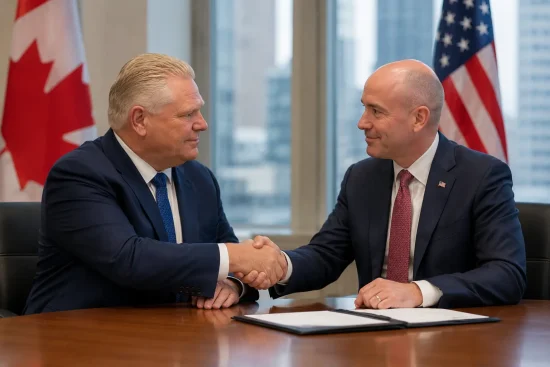
The latest major announcement is Ontario’s agreement with Utah. The Government of Ontario says Premier Doug Ford and Utah Governor Spencer Cox signed a memorandum of understanding to boost trade in key sectors, including critical minerals and advanced manufacturing.
Ford’s own public messaging also described the agreement as a way to increase cooperation between Ontario and Utah in areas such as critical minerals, advanced manufacturing and energy.
This matters because Ontario is looking beyond traditional federal-level trade negotiations. Instead of waiting only for national agreements, the province is building direct working relationships with U.S. states and Canadian provinces.
These agreements are designed to support businesses, investors and workers by identifying areas where both sides can cooperate commercially.
Why Ontario Is Targeting Utah?
Utah may not be Ontario’s largest U.S. trading partner, but it is strategically relevant. The two jurisdictions share interests in energy, technology, minerals, advanced industries and workforce development. Utah Governor Spencer Cox previously visited Ontario as part of a trade mission, and earlier reports noted that Ford wanted to build on that relationship through a memorandum of understanding.
For Ontario, Utah also represents a useful state-level partner at a time when Canada-U.S. trade relations remain uncertain. Canadian exporters continue to face tariff-related disruption, with the Government of Canada noting U.S. tariffs affecting sectors such as steel, aluminum, copper, autos, trucks, softwood lumber, furniture and semiconductors.
Is the Ontario-Utah Agreement a Free Trade Deal?
No. The Ontario-Utah arrangement should not be described as a full free trade agreement in the same legal sense as CUSMA or another federal treaty. It is a memorandum of understanding, often shortened to MOU.
An MOU usually sets out areas of cooperation rather than changing tariff law directly. It can help governments coordinate trade missions, share information, encourage investment, support workforce partnerships and create channels for businesses to explore opportunities. But it does not automatically remove tariffs, replace federal trade rules or guarantee new jobs on its own.
That distinction is important for accuracy. “Doug Ford Ontario trade deals” is a useful search phrase, but readers should understand that many of these announcements are economic cooperation agreements rather than binding international trade treaties.
How the Utah Agreement Fits Ford’s Wider Trade Strategy?
The Utah MOU is part of a broader pattern. Ontario has been signing economic cooperation agreements with U.S. states and Canadian provinces as part of Ford’s “Fortress North America” trade messaging. The goal is to make Ontario less vulnerable to sudden tariff shocks and to position the province as a reliable industrial partner for U.S. and Canadian supply chains.
Ontario’s agreement with Pennsylvania, signed in June 2026, covered areas including energy, critical minerals, advanced manufacturing, agriculture, life sciences, technology and innovation, the Great Lakes and forestry. The Pennsylvania governor’s office said the MOU also included work on an electricity transmission and trade framework between Pennsylvania and Ontario power grids.
Ontario also signed an agreement with South Carolina in June 2026. That MOU focused on cooperation in sectors including energy, nuclear technology, critical minerals, mobility, automotive and electric-vehicle manufacturing, aerospace, agri-food and life sciences. The South Carolina announcement said Ontario and South Carolina trade was valued at more than CAD $5.7 billion in 2025.
Why These Trade Deals Matter to Ontario Businesses?

For Ontario businesses, the practical value of these trade deals depends on what happens after the signing ceremony. The strongest benefits are likely to come from follow-up activity such as:
- trade missions and business matchmaking;
- investment promotion;
- supply-chain partnerships;
- energy and infrastructure cooperation;
- workforce development;
- regulatory collaboration;
- procurement access;
- critical mineral and manufacturing partnerships.
For example, the Ontario-Pennsylvania MOU created a working group to coordinate activities such as trade missions, information sharing, trade shows, workforce development, regulatory collaboration and academic collaboration.
That is the type of mechanism businesses should watch. The agreement itself creates the framework, but the business opportunity comes when agencies, industry bodies, exporters and investors use that framework to build deals.
Ontario’s Trade Deals Inside Canada
Ford’s trade strategy is not only about U.S. states. Ontario has also pursued interprovincial trade agreements to reduce internal trade barriers within Canada.
Ontario and Manitoba signed an MOU to support the removal of trade barriers between their provinces. Ontario also signed agreements with Saskatchewan, Alberta and Prince Edward Island to unlock free trade, and later signed agreements with British Columbia and Canada’s three territories.
A separate MOU involving Saskatchewan, Ontario and Alberta focused on pipelines, rail corridors, critical minerals and energy export infrastructure. The Government of Saskatchewan said the agreement was intended to coordinate the safe transportation and export of Western Canadian oil, natural gas and critical minerals to refineries, seaports and storage facilities across Canada and beyond.
The Tariff Context Behind Ford’s Trade Push
The political and economic backdrop is the continuing tariff challenge between Canada and the United States. The Government of Canada says Canadian businesses are facing disruption from various U.S. tariffs, including sectoral measures on steel, aluminum, copper, autos, buses, softwood lumber, furniture and semiconductors.
Canada has also extended certain steel and aluminum tariff measures for one year, saying the aim is to support workers, provide predictability and defend Canadian industry against global excess capacity and trade diversion.
For Ontario, this is especially sensitive because the province is heavily tied to manufacturing, autos, steel, energy, mining and cross-border supply chains. Ford’s trade deals therefore function as both economic policy and political signalling: Ontario is trying to show that it can protect jobs, build alliances and attract investment even when federal-level trade relations are strained.
What Sectors Could Benefit Most?
The main sectors likely to benefit from Ford’s Ontario trade deals are:
Critical Minerals
Ontario has major ambitions in critical minerals, especially because minerals are essential for batteries, clean technology, defence, manufacturing and energy infrastructure. Deals with Utah, Pennsylvania, South Carolina, Alberta and Saskatchewan all touch on minerals or resource supply chains.
Advanced Manufacturing
Ontario’s manufacturing base is central to the province’s pitch. Agreements with U.S. states regularly mention advanced manufacturing, automotive, mobility, aerospace or related industrial sectors.
Energy and Nuclear
Ontario is using its energy system, including nuclear power, as a trade and investment advantage. The Pennsylvania agreement included electricity cooperation, while the South Carolina MOU included energy and advanced nuclear technologies.
Automotive and Electric Vehicles
Ontario’s automotive sector remains deeply connected to U.S. supply chains. Trade agreements that cover mobility, EV manufacturing and advanced manufacturing are relevant to suppliers, battery firms, component makers and logistics companies.
Agriculture and Agri-Food
Several agreements include agriculture or agri-food. These sectors matter because food supply chains are affected by transportation, labour mobility, tariffs, standards and procurement rules.
What Are the Limits of These Agreements?

The main limitation is that MOUs are frameworks, not instant economic transformations. They do not automatically remove U.S. tariffs, override federal trade law or guarantee that companies will sign contracts.
The real test is implementation. Businesses and readers should ask:
- Are working groups created?
- Are trade missions scheduled?
- Are procurement channels opened?
- Are regulatory barriers reduced?
- Are new investments announced?
- Are Ontario exporters actually entering new markets?
- Are jobs created or protected over time?
Without measurable follow-through, an MOU can remain mostly symbolic. With serious implementation, however, it can become a useful tool for business development and investment attraction.
What Should Ontario Businesses Do Next?
Ontario businesses should treat the Utah agreement and similar trade deals as early signals rather than finished opportunities. Companies in manufacturing, mining, energy, agriculture, technology and logistics should monitor government trade missions, export programmes, buyer introductions and sector-specific events connected to these agreements.
Exporters should also review CUSMA compliance, tariff exposure and rules of origin before entering or expanding in U.S. markets. The Government of Canada’s Trade Commissioner Service advises Canadian exporters to assess how tariffs affect their business, identify new markets and connect with support services for export diversification.
Doug Ford Ontario Trade Deals: The Bottom Line
Doug Ford’s Ontario trade deals are best understood as a strategic response to a more uncertain North American economy. The Ontario-Utah MOU is the latest example of the province’s attempt to build direct trade relationships with U.S. states while also lowering barriers inside Canada.
The agreements may not be full free trade treaties, but they can still matter. If followed by trade missions, regulatory cooperation, investment projects and procurement opportunities, they could help Ontario businesses strengthen supply chains and access new markets. For now, the Utah deal shows that Ford’s government is continuing to use subnational trade diplomacy as a central part of Ontario’s economic strategy.
Sources
- CBC News — Ontario and Utah sign memorandum of understanding on economic agreement
- CTV News Toronto — Ontario signs agreement to boost trade with Utah amid ongoing trade war
- Government of Ontario — Ontario and Utah sign agreement to boost trade and create jobs in key sectors
- Government of Ontario — Ontario and Manitoba sign memorandum of understanding to tear down interprovincial trade barriers
- Government of Saskatchewan — Saskatchewan, Ontario and Alberta to advance pipelines, critical minerals and energy export infrastructure
- Government of Pennsylvania — Governor Shapiro and Premier Ford sign memorandum of understanding in Toronto
- Northern Ontario Business — Ontario and South Carolina sign agreement to increase trade and economic cooperation
- Government of Canada Trade Commissioner Service — Resources for Canadian exporters facing U.S. tariff challenges
- Department of Finance Canada — Canada extends steel and aluminum tariff measures to support workers and businesses
FAQs
What is the latest Doug Ford Ontario trade deal?
The latest highlighted agreement is Ontario’s memorandum of understanding with Utah, signed to boost trade and cooperation in sectors such as critical minerals, advanced manufacturing and energy.
Did Ontario sign a free trade agreement with Utah?
No. Ontario signed an MOU with Utah. It is an economic cooperation agreement, not a federal free trade treaty.
Why is Doug Ford signing trade deals with U.S. states?
Ford’s government is trying to strengthen Ontario’s economic links with U.S. states, support supply chains, protect jobs and reduce trade risk during a period of tariff uncertainty.
Which sectors are included in Ontario’s recent trade agreements?
Recent agreements mention sectors including critical minerals, advanced manufacturing, energy, nuclear technology, automotive, electric vehicles, aerospace, agri-food, life sciences, technology, forestry and agriculture.
Are these trade deals legally binding?
Most are memorandums of understanding. They usually create a cooperation framework rather than legally changing tariffs, customs rules or market access on their own.