




Table of Contents Show
New York City’s property-tax system has long produced a counter-intuitive result: owners of homes in less affluent outer-borough communities can pay a higher effective tax rate than owners of substantially more valuable properties in parts of Manhattan and brownstone Brooklyn.
Mayor Zohran Mamdani’s property-tax reform proposal seeks to alter that balance. The broad objective is to reduce the burden on homeowners whose properties are taxed heavily relative to their market value and shift more of it towards expensive homes that have historically benefited from favourable assessments or statutory caps.
The proposal has sometimes been described as a “racial equity tax”, largely because Mamdani’s campaign referred to moving the burden from overtaxed outer-borough homeowners to more expensive properties in “richer and whiter neighbourhoods”. However, this is not the official name of a tax, nor does the published proposal suggest that an individual owner’s race would determine their bill.
Instead, the debate concerns property values, assessment rules, housing types, neighbourhood-level inequalities and the distribution of housing wealth.
For UK readers, the controversy has some parallels with arguments over council-tax bands and outdated property valuations. However, New York City’s system is considerably more complicated, with different tax classes, valuation rules and limits on how quickly assessments can rise.
What is Mamdani’s Property-tax Reform?
Mamdani’s property-tax reform is a proposal to rebalance New York City’s existing property-tax system. It could lower bills for many homeowners in comparatively overtaxed parts of the outer boroughs while increasing liabilities for some expensive properties that currently have low taxable assessments relative to their market values.
It is not a tax imposed according to an owner’s race. Race entered the public debate because existing tax disparities often overlap with long-standing differences in neighbourhood income, property appreciation and racial composition.
The plan’s final effect remains uncertain because several important details have not been enacted as a complete reform package. Some changes could be influenced by the mayor and city authorities, while major alterations to property classifications, assessment limits and the treatment of co-operatives and condominiums may require approval from New York State.
Why is New York City’s Property-tax System Considered Unequal?
New York City does not simply apply one uniform percentage to the current sale value of every home. A property’s bill depends on several stages of calculation, including its tax class, estimated market value, assessed value, applicable assessment limits, exemptions and the tax rate set for that class.
This creates substantial differences in effective tax rates.
The effective tax rate is the annual property tax divided by the property’s market value. Two owners may therefore have houses worth similar amounts but pay noticeably different proportions of those values in tax.
The New York City Comptroller’s property-tax reform framework describes the current structure as opaque and inequitable. It says homeowners in areas including south-east Queens, eastern Brooklyn, Staten Island and the north-east Bronx can pay effective rates several times those faced by homeowners in Manhattan or affluent brownstone neighbourhoods.
The city’s Advisory Commission on Property Tax Reform has also recommended changes intended to make the system simpler, more transparent and more equitable.
Assessment Caps Can Preserve Old Advantages
New York’s assessment-growth caps restrict how quickly the taxable assessment of certain smaller residential properties can rise, even when the home’s market value increases rapidly.
These limits can protect households from sudden tax shocks. A long-term homeowner should not necessarily face an unaffordable annual bill simply because properties nearby have sold for far higher prices.
However, the caps also create accumulated advantages.
A home in a neighbourhood that experienced rapid appreciation may have a taxable assessment far below its current value. Meanwhile, a less valuable property in an area with slower appreciation may be taxed at a higher proportion of its market value.
Over time, the owner of the appreciating property can benefit in two ways: the property generates substantial housing wealth, while its annual tax liability does not rise at the same pace.
Different Property Classes Receive Different Treatment
New York City divides properties into several tax classes. Small one-to-three-family homes are treated differently from larger rental buildings, commercial premises, co-operatives and condominiums.
Co-operative and condominium valuation is especially contentious. New York State law generally requires these properties to be assessed as though they were comparable rental buildings rather than valued directly from their potential sale prices. The NYC Comptroller’s analysis of comparable-rental valuation explains how this statutory method can produce assessments that do not closely reflect ownership-market values.
The resulting system does not merely create differences between neighbourhoods. It also affects the relative tax treatment of homeowners, tenants, rental-building owners and people living in co-operatives or condominiums.
What Does Mamdani’s Property-tax Proposal Involve?
Mamdani’s original campaign platform proposed shifting part of the tax burden away from overtaxed homeowners in the outer boroughs and towards more expensive homes in wealthier neighbourhoods.
Reporting on the proposal indicated that the city could reduce the assessment percentage applied to small homes and adjust the associated tax rate. Such a change could lower bills in areas where assessments are comparatively high while increasing them for expensive homes whose taxable values remain low.
The proposal also included support for broader structural reforms such as removing or redesigning artificial assessment caps, introducing stronger income-based protections and changing the treatment of co-operatives and condominiums. Some of those measures would require action in Albany rather than a decision by City Hall alone.
A March 2026 analysis by Governing reported that one version of the proposal was estimated to reduce bills for nearly 300,000 homeowners and increase them for fewer than 200,000. Those figures should be treated as modelling of a proposal, not as guaranteed household outcomes.
A Shift Between Properties, Not a Race-based Bill
A tax bill under the proposed approach would not contain a racial category. The relevant factors would instead be matters such as:
- the property’s market and assessed values;
- its tax class;
- its location;
- the benefit received from assessment caps;
- its use as a primary or secondary residence;
- and, where relief applies, the owner’s household income.
The phrase “racial equity tax” therefore risks obscuring what the policy is designed to do.
That does not mean race is irrelevant to the underlying debate. Historical segregation, unequal access to homeownership, neighbourhood disinvestment and uneven property appreciation have shaped where wealth has accumulated.
A 2025 analysis from the Community Service Society of New York found that properties worth less than $300,000 per unit faced an effective rate three times that of properties worth more than $1 million per unit. It also reported higher effective burdens in predominantly Black neighbourhoods than in wealthier, whiter areas.
The policy question is whether the city should address those outcomes through property valuation and tax reform—and how it can do so without unfairly penalising residents who have limited income despite living in valuable homes.
Who Could Pay Less Under the Proposal?
The most likely beneficiaries would be owners of modest one-to-three-family properties whose current tax bills are high relative to their homes’ market values.
That could include households in parts of:
- Queens;
- Brooklyn;
- the Bronx;
- and Staten Island.
The change would not necessarily benefit every homeowner in those boroughs. It would depend on the individual property’s valuation, tax class and existing effective rate.
Potential beneficiaries may also include lower- and middle-income households that receive protection through a property-tax circuit breaker.
A circuit breaker links relief to household income or ability to pay. Rather than assuming that everyone in an expensive home has a high income, it can limit the burden for pensioners, long-term residents and other owners who are asset-rich but cash-poor.
The concept is not entirely new to New York. The Comptroller’s research on the burden of property taxes on lower-income households discusses existing tax credits commonly described as circuit breakers.
Who Could Pay More?
Owners most exposed to higher liabilities would generally be those holding valuable homes with comparatively low taxable assessments.
This may include:
- expensive brownstones in rapidly appreciating neighbourhoods;
- homes that have benefited significantly from assessment-growth caps;
- some co-operative or condominium owners if valuation rules change;
- owners of high-value secondary residences;
- and properties whose effective tax rates are low compared with similarly valued homes elsewhere.
However, neighbourhood averages cannot identify every household’s financial position.
A retired person who bought a home decades ago may now live in an affluent postcode without having the income associated with a newly wealthy buyer. A well-designed reform would therefore need gradual implementation, hardship provisions and clearly defined income protections.
Without these safeguards, correcting one form of inequality could create another by forcing long-term owners to sell homes they can no longer afford to retain.
How Could the Reform Shift Housing Wealth?
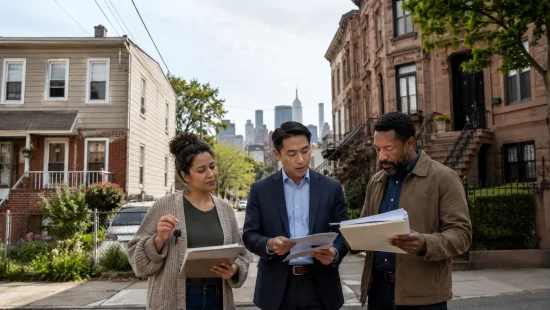
Property-tax reform does not directly transfer ownership of a house from one family to another. Its wealth effects would occur through annual housing costs, property valuations, disposable income and owners’ ability to remain in their homes.
Higher Holding Costs Could Reduce an Existing Tax Advantage
A property is both a place to live and, for an owner, an asset. Where its value rises much faster than its taxable assessment, the owner can accumulate substantial equity while paying a relatively low effective tax rate.
Increasing the recurring cost of holding such a property would reduce that advantage.
It could also affect the price a future buyer is willing to pay. Buyers generally consider mortgage repayments, insurance, maintenance and annual taxes when calculating affordability. A higher recurring tax liability can therefore place downward pressure on a property’s sale value, although interest rates, supply, demand and neighbourhood desirability may have a greater influence.
This should not be interpreted as a prediction that expensive New York homes will necessarily lose value. It means only that property taxes are one component of the cost reflected in market decisions.
Readers interested in the relationship between real estate and personal wealth can also explore Business IN Canada’s guide to the best investments in Canada, which discusses property alongside other investment types.
Lower Tax Bills Could Help Households Retain Their Homes
For an overtaxed homeowner, a lower bill could improve monthly cash flow and reduce the risk of arrears or a forced sale.
The financial benefit may appear modest in a single year, but recurring savings can become significant over a decade. They can support mortgage payments, home maintenance, insurance and other household expenses.
Property-tax relief may therefore help some families preserve ownership and pass housing wealth to the next generation.
This matters because a home is often a household’s largest asset. The ability to retain it can influence retirement security, borrowing capacity and inheritance.
Business IN Canada’s explanation of reverse mortgages in Canada illustrates the wider importance of home equity to older owners, although Canadian lending rules differ from those in the United States.
The Policy Could Influence Neighbourhood Displacement
High housing costs can displace both owners and renters.
Owners may be pushed towards a sale when taxes, insurance and maintenance become unaffordable. Renters can face displacement where landlords increase rents, convert buildings or change how properties are used.
A tax reduction for heavily burdened homeowners may support stability in some communities. Conversely, a steep increase without adequate protection could create pressure in neighbourhoods where market values have risen faster than residents’ incomes.
The distributional result will therefore depend on more than which postcodes pay more. The phase-in period and relief arrangements may be just as important as the headline tax shift.
Could Landlords Pass Higher Property Taxes to Renters?
Some landlords may try to recover higher costs through rents, but a direct one-for-one transfer is not automatic.
The outcome would depend on:
- whether the unit is rent-regulated;
- the landlord’s ability to increase the rent legally;
- local demand and vacancy levels;
- the terms of the tenancy;
- the building’s other operating costs;
- and competition from alternative housing.
Rental buildings already receive different tax treatment from many owner-occupied properties. Reform advocates argue that large apartment buildings can face heavier effective burdens than expensive co-operatives and condominiums, indirectly raising the cost of rental housing.
The NYC Comptroller’s property-tax proposals have therefore called for homeowner reform to be considered alongside changes affecting multifamily construction and affordable rentals.
Illustrative Example: Two Homes With Unequal Burdens
The following example is hypothetical. It explains the policy mechanism rather than predicting actual bills.
| Property | Estimated market value | Existing tax position | Possible effect of reform |
|---|---|---|---|
| Outer-borough family home | $850,000 | Comparatively high effective rate | Bill could fall |
| Appreciated brownstone | $2.5 million | Low assessment relative to market value | Bill could rise |
| Long-term, low-income owner | $1.5 million | Higher reassessment could cause hardship | Circuit-breaker relief could limit the increase |
| Luxury second residence | $6 million | Not the owner’s main home | Could face a separate surcharge |
Suppose the $850,000 family home is taxed on a relatively high proportion of its market value, while the $2.5 million brownstone benefits from years of capped assessment growth.
A reform that brings effective rates closer together might reduce the first household’s annual bill and increase the second household’s.
The third owner demonstrates why income protection matters. A property can be valuable on paper while its occupant has limited cash income. A circuit breaker could prevent the corrected assessment from producing an unaffordable bill.
The fourth example concerns a separate policy: New York’s proposed pied-à-terre surcharge.
Is the Reform the Same as Mamdani’s Other Property-tax Plans?
No. Several distinct policies have appeared in New York’s 2026 tax debate, and they should not be conflated.
Structural Property-tax Reform
This is the longer-term plan to correct unequal assessments and redistribute liabilities between properties and neighbourhoods.
Its stated purpose is fairness within the tax system rather than simply raising more revenue.
The Proposed 9.5% General Increase
Mamdani’s February 2026 preliminary budget assumed a 9.5% property-tax rate increase if the city did not receive additional revenue authority. The proposal was expected to generate approximately $3.7 billion in the 2027 financial year.
That was a broad budget-balancing measure, not the same as the targeted neighbourhood and assessment reform.
The later executive budget removed the general increase. The NYC Comptroller said the revised plan replaced a broad property-tax rise with a more targeted surcharge on certain luxury secondary homes.
The Pied-à-terre Proposal
In April 2026, Mamdani and Governor Kathy Hochul announced a proposed surcharge on high-value secondary residences owned by people whose primary residence is outside New York City.
A pied-à-terre tax targets the use and value of a secondary property. It is therefore distinct from a citywide effort to correct assessment disparities among primary homes.
The Comptroller subsequently published an analysis of the pied-à-terre tax and its potential revenue, including some of the practical difficulties involved in identifying and valuing eligible properties.
Can New York City’s Mayor Implement the Reform Alone?

Only partly.
The mayor and city administration have influence over budget proposals, administrative priorities, assessment practices within statutory limits and the tax rates presented through the city’s fiscal process.
However, New York State law controls important parts of the system.
Changes to assessment caps, property classifications and the statutory treatment of co-operatives and condominiums may require legislation in Albany. The mayor would therefore need support from the governor and state lawmakers to complete a comprehensive overhaul.
This division of authority helps explain why New York politicians have criticised property-tax inequality for years without replacing the system.
Reform creates identifiable winners and losers. Elected representatives may support fairness in principle but resist measures that raise bills for a significant number of their constituents.
How Does Nyc Property Tax Compare With UK Council Tax?
New York City property tax and UK council tax are both local revenue mechanisms connected to residential property, but they operate differently.
| Feature | New York City property tax | UK council tax |
|---|---|---|
| Main structure | Property classes, assessments and class-specific rates | Domestic valuation bands |
| Valuation | Current estimates modified by statutory rules and caps | Usually based on historic valuation dates |
| Who pays | Generally the property owner | Usually the resident or liable occupier |
| Common criticism | Unequal effective rates and complex classifications | Outdated valuations and a limited upper-band structure |
| Reform difficulty | Requires coordination between city and state | Requires political decisions on revaluation, bands and local-government funding |
In both systems, outdated or constrained valuations can weaken the link between present property wealth and the amount paid.
The comparison is useful because it shows why tax reform becomes politically difficult. Updating liabilities may make the system more internally consistent, but it also produces households whose bills increase immediately.
UK readers examining wider affordability pressures may also find Business IN Canada’s overview of the most expensive cities in Canada useful for comparing how housing costs influence different urban economies.
Arguments in Favour of Mamdani’s Reform
Supporters argue that the existing system violates a basic principle of taxation: properties with similar values should generally face comparable effective burdens.
They contend that reform could:
- reduce excessive bills for working- and middle-income homeowners;
- limit the benefit enjoyed by highly appreciated properties;
- make the system easier to understand;
- address disparities between neighbourhoods;
- protect vulnerable owners through income-based relief;
- and reduce uneven treatment between rental and owner-occupied housing.
The issue is not confined to one political faction. Calls for comprehensive reform have included elected representatives, housing organisations and policy advocates with differing views on other parts of Mamdani’s agenda.
Arguments Against the Proposal
Critics raise both practical and political concerns.
The campaign’s use of “whiter neighbourhoods” was criticised as unnecessarily divisive. Opponents argue that tax rules should be presented through property values and household circumstances rather than neighbourhood racial composition.
Others question whether the proposal has been modelled in enough detail. A broad promise to make wealthy areas pay more does not reveal precisely how each property would be affected or whether the total package would remain revenue-neutral.
Further concerns include:
- sudden increases for long-term homeowners;
- pressure on residents with low incomes;
- possible rent increases;
- effects on property values;
- complex appeals and reassessments;
- and the risk of reforming small homes without correcting burdens on rental housing.
These concerns do not establish that reform is unnecessary. They demonstrate why the final legislation, impact modelling and transition arrangements matter.
What Details Remain Unresolved?

Before owners can determine how Mamdani’s property-tax reform would affect them, policymakers will need to publish a complete framework.
Important unresolved questions include:
- Which properties would be reassessed?
- How quickly would higher liabilities be phased in?
- What income levels would qualify for circuit-breaker protection?
- Would pensioners receive additional relief?
- How would co-operatives and condominiums be valued?
- Would rental-building rates also change?
- Would the reform raise additional revenue or remain revenue-neutral?
- Which measures would require state legislation?
- How could an owner appeal an inaccurate valuation?
- Would neighbourhood-level impact tables be publicly available?
Clear answers will be essential if the administration wants to demonstrate that the reform is based on measurable tax disparities rather than broad political descriptions of neighbourhoods.
What Happens Next?
The next meaningful stage would be a formal proposal containing property-level modelling, legal mechanisms, a timetable and protections for vulnerable owners.
New Yorkers should look for:
- City Council hearings;
- negotiations with New York State;
- detailed estimates of households paying more or less;
- rules for gradual implementation;
- income-based hardship protections;
- and analysis of effects on renters and housing supply.
The existence of a widely recognised problem does not guarantee that Mamdani’s preferred solution will be enacted unchanged.
The city’s property-tax system contributes roughly a third of municipal revenue, according to the Comptroller’s reform material. Altering it therefore affects not only homeowners but also the funding available for schools, sanitation, transport-related services and other public programmes.
Key takeaways
Mamdani’s property-tax reform is best understood as an attempt to redistribute New York City’s existing tax burden according to property value and current tax treatment.
It is not an individual tax based on race, even though racial and neighbourhood inequality form part of the political argument surrounding it.
Many owners of modest homes in comparatively overtaxed areas could benefit. Owners of expensive properties that have low assessed values relative to market prices could pay more.
The reform could shift housing wealth over time by changing annual ownership costs, disposable income, property valuations and households’ ability to remain in their homes.
Its fairness will ultimately depend on the details: valuation methods, income protections, phase-in arrangements, treatment of rental housing and transparent modelling of who gains and who loses.
Conclusion
Mamdani’s property-tax reform addresses a genuine and extensively documented weakness in New York City’s fiscal system. Homes of similar value can carry very different effective tax burdens, while some properties in rapidly appreciating areas have accumulated wealth without experiencing a comparable rise in taxable assessments.
Rebalancing those liabilities could provide relief to homeowners in heavily taxed outer-borough communities and reduce the advantages attached to some expensive properties.
However, the proposal should not be described as a completed policy or a literal race-based tax. Comprehensive reform will require detailed legislation, political cooperation and safeguards for residents who live in valuable properties but do not have high incomes.
For the policy to succeed, City Hall will need to show more than a persuasive fairness argument. It will need to publish the numbers, explain the legal route and prove that the shift can correct structural inequality without causing avoidable displacement.
FAQs
Is Mamdani’s Property-tax Reform Based on Race?
No. The published proposal concerns property values, assessments, tax classes and neighbourhood-level disparities. It does not establish different individual rates according to an owner’s race.
Has Mamdani’s Property-tax Reform Become Law?
A complete structural reform package has not been presented as fully enacted. Some major changes would require the support of New York State lawmakers.
Which Homeowners Could Pay Less?
Owners of modest homes with comparatively high effective tax rates, particularly in parts of the outer boroughs, could benefit. Actual outcomes would depend on the final formula.
Which Properties Could Pay More?
Expensive homes with relatively low taxable assessments, properties that have benefited heavily from assessment caps and some luxury secondary residences could face higher liabilities under different proposals.
What is a Property-tax Circuit Breaker?
It is a form of relief that limits a household’s property-tax burden according to income or ability to pay.
Could the Proposal Increase Rents?
Landlords may try to pass on higher costs, but rent regulation, market conditions and the building’s circumstances would determine whether they could do so.
Could the Reform Reduce Property Prices?
Higher recurring taxes can affect buyer affordability and may place downward pressure on some valuations. However, property prices also depend on supply, demand, interest rates and local economic conditions.
Can the Nyc Mayor Change the System Without State Approval?
The mayor can influence some rates and administrative policies, but major changes to classifications, assessment limits and co-operative or condominium rules may require state legislation.
Is the Plan the Same as the Proposed 9.5% Property-tax Rise?
No. The 9.5% rise appeared in the February 2026 preliminary budget as a broad revenue measure. It was later removed from the executive budget.
Is the Plan the Same as the Pied-à-terre Tax?
No. The pied-à-terre proposal targets certain luxury secondary residences owned by people whose main home is outside New York City.