



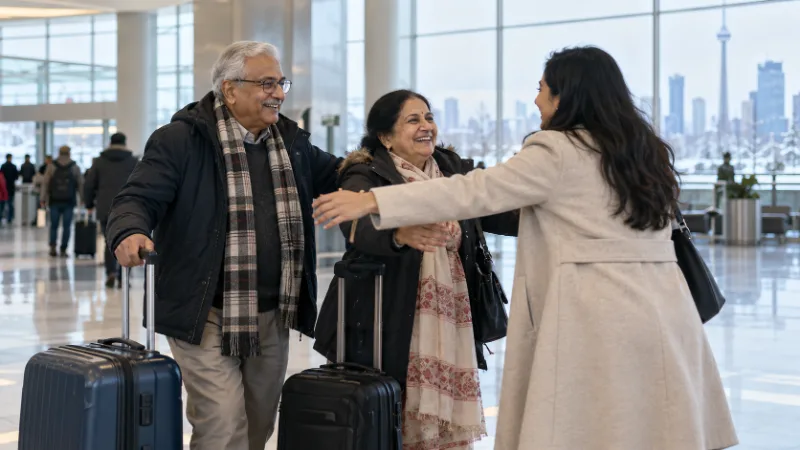
How to Apply for a Parents Visitor Visa in Canada? 2026 Guide

How to Apply for a Parents Visitor Visa in Canada 2026 Guide
Table of Contents Show
  1. Quick Answer: Which Visa Should Parents Apply For?
  2. What Is a Parents Visitor Visa in Canada?
    1. Visitor Visa vs Super Visa: Which One Is Better for Parents?
  3. Who Can Apply for a Parents Visitor Visa in Canada?
    1. Basic Requirements for a Parents Visitor Visa
  4. Documents Required for a Parent’s Visitor Visa Application
    1. 1. Passport
    2. 2. Visitor Visa Application Forms
    3. 3. Letter of Invitation from the Child or Grandchild in Canada
    4. 4. Proof of Relationship
    5. 5. Proof of Funds
    6. 6. Proof of Employment, Business, or Pension
    7. 7. Proof of Home Country Ties
    8. 8. Travel Itinerary
    9. 9. Statement of Purpose
  5. How to Write a Strong SOP for Parents Visitor Visa Canada?
    1. 1. Introduction
    2. 2. Purpose of Visit
    3. 3. Travel Plan
    4. 4. Financial Support
    5. 5. Ties to Home Country
    6. 6. Compliance Statement
  6. How to Apply for a Parents Visitor Visa in Canada?
    1. Step 1: Confirm Whether Your Parents Need a Visitor Visa
    2. Step 2: Decide Between Visitor Visa and Super Visa
    3. Step 3: Create or Sign In to the IRCC Portal
    4. Step 4: Upload Documents
    5. Step 5: Pay the Fees
    6. Step 6: Give Biometrics, If Required
    7. Step 7: Wait for Processing
    8. Step 8: Submit Passport If Approved
  7. How Much Does a Parents Visitor Visa Cost in 2026?
    1. Super Visa Requirements for Parents and Grandparents
    2. Super Visa Insurance Requirement
    3. Super Visa Income Requirement
  8. How Long Can Parents Stay in Canada?
  9. How Long Does a Parents Visitor Visa Take?
  10. Common Reasons Parents Visitor Visas Are Refused
    1. 1. Weak Home Country Ties
    2. 2. Vague Purpose of Visit
    3. 3. Inconsistent Finances
    4. 4. Long Visit With Weak Explanation
    5. 5. Missing Proof of Relationship
    6. 6. Previous Refusals Not Explained
  11. Can Parents Work in Canada on a Visitor Visa?
  12. What to Do If a Parents Visitor Visa Is Refused?
  13. Parents Visitor Visa Canada Checklist
    1. Host Documents
    2. Super Visa Extra Documents
  14. Frequently Asked Questions
    1. Can I apply for a visitor visa for my parents from Canada?
    2. Is there a special “parents visitor visa” category?
    3. How much bank balance is required for a parents visitor visa in Canada?
    4. Is an invitation letter mandatory?
    5. Can parents stay in Canada for more than 6 months?
    6. Can my parents convert a visitor visa to permanent residence?
    7. Does a visitor visa guarantee entry to Canada?
    8. Can my parents bring medicines to Canada?
    9. Should my parents buy tickets before visa approval?
    10. What is the biggest mistake in parents visitor visa applications?
  15. Sources with Links

Last updated: 27.06.2026

Official sources checked: Immigration, Refugees and Citizenship Canada (IRCC), Government of Canada

Important note: This guide is for general information only. Canadian immigration rules, fees, forms, and processing times can change. Always check the official IRCC website before submitting an application or speak with a licensed Canadian immigration lawyer or Regulated Canadian Immigration Consultant if your case is complex.

Planning to bring your parents to Canada for a family visit? In most cases, parents can visit Canada using either a standard visitor visa, also called a Temporary Resident Visa or TRV, or a Parent and Grandparent Super Visa.

The right option depends on how long your parents want to stay, whether they need medical insurance, and whether the child or grandchild in Canada meets the income requirement.

This 2026 guide explains the difference between a regular parents visitor visa and a Super Visa, who can apply, what documents are needed, how much it costs, how to apply, and how to reduce the risk of refusal.

Quick Answer: Which Visa Should Parents Apply For?

Parents should usually apply for a standard visitor visa if they are coming to Canada for a short family visit, vacation, ceremony, birth of a grandchild, graduation, or special occasion.

They should consider a Parent and Grandparent Super Visa if they want to stay in Canada for more than 6 months at a time and are visiting a Canadian citizen, permanent resident, or registered Indian child or grandchild.

Feature Standard Visitor Visa Parent and Grandparent Super Visa
Best for Short visits, family events, tourism Longer stays with children or grandchildren
Typical stay Up to 6 months per entry unless a border officer allows otherwise Up to 5 years at a time for eligible applicants
Validity May be issued as single or multiple entry, often up to passport validity Multiple-entry visa, often up to 10 years or passport validity
Medical insurance Strongly recommended but not always mandatory Mandatory
Medical exam May be requested depending on stay length and circumstances Required
Host income requirement No fixed IRCC minimum for standard visitor visa Host must meet minimum necessary income
Best for parents who Have a short and clear visit plan Want extended family stays in Canada

What Is a Parents Visitor Visa in Canada?

What Is a Parents Visitor Visa in Canada

A parents visitor visa is not a separate visa category. It usually refers to a standard Canadian visitor visa used by a parent or grandparent to visit their child or grandchild in Canada.

A visitor visa is an official document placed in the passport. It shows that the applicant meets the requirements to travel to Canada as a temporary visitor. However, it does not guarantee entry. The final decision is made by a Canada Border Services Agency officer when the person arrives in Canada.

Parents visiting Canada must show that they are genuine temporary visitors. This means they must satisfy the visa officer that they will leave Canada at the end of their authorized stay.

Visitor Visa vs Super Visa: Which One Is Better for Parents?

Choosing the right visa is one of the most important parts of the application.

A standard visitor visa is better when the visit is short, such as a 2-week holiday, a graduation, a wedding, a family reunion, or a short stay after the birth of a grandchild.

A Super Visa is better when parents or grandparents want to stay in Canada for an extended period. The Super Visa is specifically designed for parents and grandparents of Canadian citizens, permanent residents, or registered Indians who live in Canada.

The Super Visa has stricter requirements. The host must meet income rules, provide a signed invitation letter, and the applicant must have valid private health insurance and complete a medical exam.

Who Can Apply for a Parents Visitor Visa in Canada?

Parents may apply for a visitor visa if they want to visit Canada temporarily and meet Canada’s visitor requirements.

To qualify, the applicant should generally be able to show:

  • A valid passport or travel document
  • A clear purpose of visit
  • Enough money for the trip
  • Strong ties to the home country
  • A plan to leave Canada at the end of the authorized stay
  • No serious criminal or immigration issues
  • Good health, if a medical exam is requested
  • Truthful and complete information in the application

For a standard visitor visa, the child in Canada does not always need to be a Canadian citizen or permanent resident. For example, parents may visit a child who is in Canada on a study permit or work permit. However, the visitor must still prove that the trip is temporary.

For a Super Visa, the host must be the applicant’s child or grandchild and must be one of the following:

  • A Canadian citizen
  • A permanent resident of Canada
  • A person registered in Canada as an Indian under the Canadian Indian Act

The host must also be at least 18 years old, live in Canada, meet the income requirement, and provide a signed letter of invitation.

Basic Requirements for a Parents Visitor Visa

A strong parent’s visitor visa application should clearly explain the full travel story.

The application should answer these questions:

  • Who is travelling to Canada?
  • Who are they visiting?
  • Why are they visiting now?
  • How long will they stay?
  • Where will they stay?
  • Who will pay for the trip?
  • What ties do they have to their home country?
  • Why will they leave Canada on time?

Visa refusals often happen when these answers are unclear, unsupported, or inconsistent.

Documents Required for a Parent’s Visitor Visa Application

Documents Required for a Parents Visitor Visa Application

The exact document checklist can vary depending on the applicant’s country, personal circumstances, and the IRCC portal checklist. However, most parents’ visitor visa applications should include the following documents.

1. Passport

The passport should be valid and should ideally cover the full intended travel period. A visa cannot normally be issued beyond passport validity.

Applicants should provide clear scans of the passport information page and any pages showing previous visas, travel stamps, or immigration history.

2. Visitor Visa Application Forms

The applicant must complete the required online forms through the IRCC portal. The answers must be accurate and consistent with the supporting documents.

Do not guess dates, employment history, travel history, or family details. Inaccurate information can lead to refusal and, in serious cases, a finding of misrepresentation.

3. Letter of Invitation from the Child or Grandchild in Canada

A letter of invitation helps explain the purpose of the visit. It does not guarantee approval, but it can make the application clearer and stronger.

The invitation letter should include:

  • Host’s full legal name
  • Host’s date of birth
  • Host’s Canadian address and phone number
  • Host’s job title and employer, if applicable
  • Host’s status in Canada
  • Visitor’s full name and date of birth
  • Relationship between the host and visitor
  • Purpose of visit
  • Planned length of stay
  • Address where the visitor will stay
  • Who will pay for travel, food, accommodation, insurance, and daily expenses
  • Planned departure date from Canada

The host should attach proof of Canadian status, such as a Canadian passport, citizenship certificate, PR card, or status card, depending on their situation.

For a Super Visa, the invitation letter must also include a promise of financial support and the list and number of people used in the family size calculation.

4. Proof of Relationship

Parents should include proof that they are related to the child or grandchild in Canada.

Useful documents may include:

  • Birth certificate showing the parent-child relationship
  • Adoption documents, if applicable
  • Marriage certificate, if names changed after marriage
  • Family registration documents, if applicable
  • Government-issued family records, if available

If documents are not in English or French, certified translations may be required.

5. Proof of Funds

Parents must show that they can afford the trip, or that the host in Canada can support them.

Useful financial documents may include:

  • Bank statements
  • Pension statements
  • Employment income proof
  • Business income records
  • Tax returns
  • Fixed deposit or investment records
  • Property rental income documents
  • Host’s employment letter, pay slips, Notice of Assessment, or bank statements if the host is paying

There is no official “show money” amount for a standard visitor visa. The right amount depends on the length of stay, accommodation plan, flight costs, travel plans, and who is paying for expenses.

A short visit staying with family usually requires less proof of funds than a long visit involving hotels, internal travel, and tourism.

6. Proof of Employment, Business, or Pension

This is important because it helps show ties to the home country.

If the parent is employed, include:

  • Employment letter
  • Approved leave letter
  • Recent pay slips
  • Income tax documents
  • Employer contact details

If the parent is self-employed or owns a business, include:

  • Business registration
  • Tax filings
  • Business bank statements
  • Invoices or contracts
  • Proof of business activity

If the parent is retired, include:

  • Pension documents
  • Retirement certificate
  • Pension bank deposits
  • Proof of investments or rental income, if applicable

7. Proof of Home Country Ties

This is one of the most important parts of the application.

IRCC officers assess whether the applicant is likely to leave Canada at the end of the visit. Parents should not only say they will return home; they should prove it.

Strong home country ties may include:

  • Property ownership
  • Land records
  • Active business ownership
  • Pension entitlement
  • Employment commitments
  • Dependent family members in the home country
  • Medical responsibilities
  • Community responsibilities
  • Return travel plans
  • Ongoing financial commitments

The application should show that the applicant has a stable life outside Canada and strong reasons to return.

8. Travel Itinerary

A travel itinerary helps show that the visit is planned and temporary.

It can include:

  • Proposed arrival date
  • Proposed departure date
  • Cities to be visited
  • Family events
  • Tourist activities
  • Accommodation details
  • Weekend trips
  • Return flight plan, if available

Avoid vague statements such as “tourism” or “family visit” without details. A clear, realistic plan is stronger.

9. Statement of Purpose

A Statement of Purpose, also called an SOP or letter of explanation, is not always mandatory, but it is very helpful in parent visitor visa applications.

It should explain the full case in a simple and honest way.

A strong SOP should cover:

  1. Who the applicants are
  2. Why they want to visit Canada
  3. Who they will visit
  4. How long they will stay
  5. Who will pay for the trip
  6. What they plan to do in Canada
  7. What ties they have to their home country
  8. Why they will leave Canada before their authorized stay ends

The SOP should be specific. For example, instead of saying “We want to visit Canada for tourism,” say “We want to visit our daughter in Mississauga for four weeks during her maternity recovery period and spend time with our new grandchild. We also plan to visit Niagara Falls for one weekend before returning to India on the planned departure date.”

If the visit is connected to pregnancy, childbirth, or grandchildren, be careful with wording. Emotional support and family bonding are acceptable visitor purposes. However, the applicant should not describe the trip as full-time childcare, nanny work, or household employment.

How to Write a Strong SOP for Parents Visitor Visa Canada?

A well-written SOP can reduce confusion and help the officer understand the application.

Use this structure.

1. Introduction

Start with the applicants’ names, ages, nationality, and current situation.

Example:

“We are applying for a temporary visitor visa to visit our son in Canada for four weeks. We currently live in India, where we own our home and receive regular pension income.”

2. Purpose of Visit

Explain why the visit is happening now.

Good reasons may include:

  • Visiting a child or grandchild
  • Attending a graduation
  • Attending a wedding
  • Helping celebrate a birthday or anniversary
  • Meeting a newborn grandchild
  • Tourism with family
  • Spending a short holiday with relatives

The purpose should be genuine, specific, and supported by documents where possible.

3. Travel Plan

Provide a simple schedule.

Example:

  • Week 1: Stay with daughter in Brampton
  • Week 2: Family time and local sightseeing
  • Week 3: Visit Niagara Falls and Toronto attractions
  • Week 4: Attend family ceremony and return home

The itinerary does not need to be complicated. It only needs to show that the visit has a clear beginning and end.

4. Financial Support

Explain who will pay for what.

For example:

  • Parents will pay for flights
  • Host will provide accommodation
  • Host will cover food and local travel
  • Parents have pension income and savings for personal expenses

Financial documents should match the explanation.

5. Ties to Home Country

This is the strongest part of the SOP.

Mention:

  • Property
  • Pension
  • Employment
  • Business
  • Family members remaining at home
  • Social and community responsibilities
  • Medical commitments
  • Financial responsibilities

Do not exaggerate. Provide documents where possible.

6. Compliance Statement

End by confirming that the applicants understand the temporary nature of the visa and will leave Canada before their authorized stay expires.

How to Apply for a Parents Visitor Visa in Canada?

How to Apply for a Parents Visitor Visa in Canada

Most visitor visa applications are submitted online through the IRCC portal.

Step 1: Confirm Whether Your Parents Need a Visitor Visa

Some travellers need a visitor visa, while others may need an electronic travel authorization, depending on citizenship and method of travel.

Use the official Government of Canada tool to check what travel document your parents need before applying.

Step 2: Decide Between Visitor Visa and Super Visa

Choose a standard visitor visa if the visit is short.

Choose a Super Visa if your parents or grandparents want to stay in Canada for more than 6 months at a time and meet the Super Visa requirements.

Step 3: Create or Sign In to the IRCC Portal

The applicant or authorized representative must sign in to the IRCC portal and complete the online application.

The portal will ask questions and generate a document checklist based on the applicant’s answers.

Step 4: Upload Documents

Upload clear and complete documents.

Documents should be easy to read, properly named, and consistent. Do not upload unclear scans, cropped pages, or documents that do not match the information in the application form.

Step 5: Pay the Fees

The visitor visa processing fee is generally CAD $100 per person. Biometrics, if required, are generally CAD $85 per person.

If multiple family members apply together, family caps may apply to some fees.

Step 6: Give Biometrics, If Required

Many applicants must provide fingerprints and a photo. After submitting the application, IRCC sends a biometrics instruction letter if biometrics are needed.

Book the biometrics appointment as soon as possible because processing time does not usually include the time taken to complete biometrics.

Step 7: Wait for Processing

Processing times vary by country and application volume. They can also change depending on whether the application is complete, how quickly IRCC can verify the information, and whether extra documents, an interview, a medical exam, or a police certificate are requested.

Do not rely on old processing-time tables. Check IRCC’s live processing-time tool before publishing or applying.

Step 8: Submit Passport If Approved

If the application is approved, IRCC will send instructions for passport submission. The applicant cannot travel to Canada until the visa is placed in the passport, unless they are visa-exempt and have the required travel authorization.

How Much Does a Parents Visitor Visa Cost in 2026?

The standard visitor visa fee is generally:

Fee Type Amount
Visitor visa processing fee CAD $100 per person
Visitor visa family application fee CAD $500 for a family of 5 or more, if eligible
Biometrics CAD $85 per person
Biometrics family fee Up to CAD $170, if eligible

For a single parent who needs biometrics, the basic government cost is usually:

CAD $100 visitor visa fee + CAD $85 biometrics fee = CAD $185

For two parents applying together, the basic cost is usually:

CAD $200 visitor visa fees + CAD $170 biometrics family fee = CAD $370

Other costs may include:

  • Passport photos
  • Document translation
  • Medical exam, if requested
  • Travel insurance
  • Courier fees
  • Immigration consultant or lawyer fees, if used
  • Flight bookings, if purchased
  • Super Visa medical insurance, if applying for a Super Visa

Always confirm the current fee on the official IRCC fee page before paying.

Super Visa Requirements for Parents and Grandparents

The Super Visa has extra requirements compared with a standard visitor visa.

To apply for a Super Visa, the parent or grandparent must:

  • Be outside Canada when applying
  • Be the parent or grandparent of the host
  • Have a host who is a Canadian citizen, permanent resident, or registered Indian
  • Have a host who is at least 18 and lives in Canada
  • Have a signed letter of invitation from the host
  • Show that the host meets the minimum necessary income
  • Have valid private health insurance
  • Complete an immigration medical exam
  • Meet general visitor requirements

Super Visa Insurance Requirement

Super Visa applicants must provide proof of private health insurance.

The policy should:

  • Be valid for at least 1 year from the date of entry
  • Be paid in full or paid in instalments with a deposit
  • Cover health care, hospitalization, and repatriation
  • Provide at least CAD $100,000 in emergency coverage
  • Be valid for each entry to Canada
  • Be available for review by border officers on request

The insurance must be from a Canadian insurance company or from a foreign insurance company that meets IRCC’s accepted conditions.

Quotes alone are not accepted.

Super Visa Income Requirement

For a Super Visa, the host must meet the minimum necessary income based on family size.

Family size may include:

  • The host
  • The host’s spouse or common-law partner
  • Dependent children
  • The visiting parent or grandparent
  • Any person the host or co-signer is still financially responsible for under a sponsorship undertaking

As of the latest official IRCC table checked for this update, the minimum income amounts are:

Family Size Minimum Income Required
1 CAD $30,526
2 CAD $38,002
3 CAD $46,720
4 CAD $56,724
5 CAD $64,336
6 CAD $72,560
7 CAD $80,784
Each additional person Add CAD $8,224

IRCC changed how Super Visa income can be calculated from March 31, 2026. Hosts may be able to meet the income requirement using either of the two taxation years before the application. In some cases, the visiting parent or grandparent’s income may also be added if the host meets the required minimum percentage.

Because this rule is technical, hosts should check the current IRCC guidance before applying.

How Long Can Parents Stay in Canada?

How Long Can Parents Stay in Canada

With a standard visitor visa, parents can usually stay in Canada for up to 6 months from the date they enter, unless a border officer gives a different date.

The visa expiry date is not the same as the authorized stay period. The visa expiry date tells the traveller the last date they can use the visa to seek entry to Canada. The authorized stay is decided at the border or shown on a visitor record.

If parents want to stay longer, they should apply for a visitor record at least 30 days before their current status expires.

With a Super Visa, eligible parents and grandparents may stay in Canada for up to 5 years at a time.

How Long Does a Parents Visitor Visa Take?

Processing times are not fixed. They vary by country, visa office, volume of applications, biometrics, completeness, verification, and whether IRCC asks for additional documents.

A better YMYL approach is to avoid promising exact timelines in the article. Instead, tell readers to check the official IRCC processing-time tool before applying.

Applications can be delayed if:

  • Forms are incomplete
  • Biometrics are delayed
  • Documents are unclear
  • Financial evidence is inconsistent
  • Travel purpose is vague
  • IRCC requests a medical exam or police certificate
  • The applicant has previous refusals or immigration issues

Common Reasons Parents Visitor Visas Are Refused

Common Reasons Parents Visitor Visas Are Refused

A refusal does not always mean the parent can never visit Canada. However, the next application should directly address the refusal reasons.

Common refusal reasons include:

1. Weak Home Country Ties

This is one of the most common refusal issues. The officer may not be satisfied that the parent will leave Canada at the end of the visit.

To reduce this risk, include strong evidence such as property ownership, pension income, employment, business activity, dependent family members, and community ties.

2. Vague Purpose of Visit

A short sentence like “I want to visit my child in Canada” may not be enough.

A stronger explanation includes dates, occasion, accommodation, travel plan, and who will pay for expenses.

3. Inconsistent Finances

Financial documents should tell a clear and believable story.

Avoid depositing a large unexplained amount into the applicant’s bank account shortly before applying. If there is a large deposit, explain the source with documents, such as sale of property, maturity of fixed deposit, pension arrears, or business income.

4. Long Visit With Weak Explanation

A long visit may raise concerns if the parent has limited funds, weak home ties, or unclear reasons for staying so long.

If the intended stay is long, explain why that length is reasonable and how the parent will be supported.

5. Missing Proof of Relationship

If the application does not clearly prove the parent-child relationship, the officer may not be satisfied about the purpose of visit.

6. Previous Refusals Not Explained

If the parent was previously refused a visa by Canada or another country, disclose it honestly and explain what has changed since the refusal.

Never hide a refusal. Misrepresentation can create much more serious immigration problems.

Can Parents Work in Canada on a Visitor Visa?

No. A visitor visa does not give parents the right to work in Canada.

Parents can visit family, travel, attend family events, and spend time with children or grandchildren. However, they should not work or provide services that would normally be considered employment.

If the visit is connected to a newborn or family support, describe it carefully as family bonding and emotional support. Avoid presenting the visit as unpaid full-time childcare or nanny work.

What to Do If a Parents Visitor Visa Is Refused?

What to Do If a Parents Visitor Visa Is Refused

If your parents’ visitor visa is refused, read the refusal letter carefully. The letter usually explains the main concerns.

Before reapplying, identify what went wrong.

Ask:

  • Was the purpose of visit clear?
  • Were home country ties strong enough?
  • Were financial documents consistent?
  • Was the invitation letter detailed?
  • Was the relationship proven?
  • Was the travel plan realistic?
  • Were previous refusals disclosed?
  • Was any document missing or unclear?

Do not immediately resubmit the same application with the same documents. A stronger reapplication should address the officer’s concerns with better evidence.

For complex cases, multiple refusals, previous immigration issues, inadmissibility concerns, or suspected misrepresentation, it is safer to speak with a licensed Canadian immigration lawyer or Regulated Canadian Immigration Consultant.

Parents Visitor Visa Canada Checklist

Use this checklist before submitting.

Applicant Documents

  • Valid passport
  • Completed IRCC forms
  • Digital photo, if required
  • Bank statements
  • Proof of income
  • Employment letter, business documents, or pension proof
  • Tax documents, if available
  • Property documents, if available
  • Family ties evidence
  • Travel history
  • Previous visa refusal letters, if any
  • Statement of Purpose
  • Travel itinerary
  • Translations, if required

Host Documents

  • Letter of invitation
  • Proof of Canadian status
  • PR card, citizenship proof, Canadian passport, or status card
  • Canadian address proof
  • Employment letter
  • Pay slips
  • Notice of Assessment, if available
  • Bank statements, if supporting the trip
  • Proof of relationship with the applicant

Super Visa Extra Documents

  • Proof of private health insurance
  • Medical exam proof
  • Host income proof
  • Family size calculation
  • Financial support promise in invitation letter

Conclusion

Applying for a parents visitor visa in Canada is not only about filling out forms. A successful application should clearly prove that the visit is genuine, temporary, affordable, and well planned.

For short visits, a standard visitor visa may be enough. For longer stays with children or grandchildren in Canada, the Super Visa may be the better route.

Before applying, check the latest IRCC rules, prepare strong documents, write a clear invitation letter, explain the purpose of visit properly, and provide strong proof that your parents will return home after their stay.

Because immigration decisions depend on individual circumstances, no guide can guarantee approval. However, a complete, honest, and well-documented application gives your parents the best chance of a successful result.

Frequently Asked Questions

Can I apply for a visitor visa for my parents from Canada?

You can help your parents prepare their application from Canada, but the application belongs to your parents. They must provide truthful information and sign or submit the application as required. If a representative is used, they must be properly authorized.

Is there a special “parents visitor visa” category?

No. Most people use the term “parents visitor visa” to mean a standard visitor visa for parents. The separate parent-specific option is the Parent and Grandparent Super Visa.

How much bank balance is required for a parents visitor visa in Canada?

There is no official fixed minimum for a standard visitor visa. The amount should be reasonable for the length of stay, flights, accommodation, insurance, food, transport, and planned activities.

The officer will look at the full financial picture, not only the final bank balance.

Is an invitation letter mandatory?

For family visits, an invitation letter is strongly recommended and is commonly included. For a Super Visa, the host’s signed invitation letter is required and must include a promise of financial support.

Can parents stay in Canada for more than 6 months?

On a standard visitor visa, parents can usually stay for up to 6 months unless allowed otherwise. To stay longer, they should apply for a visitor record before their status expires.

For longer stays, the Super Visa may be a better option because eligible parents and grandparents can stay for up to 5 years at a time.

Can my parents convert a visitor visa to permanent residence?

A visitor visa is temporary. It does not automatically lead to permanent residence.

Parents may be eligible for permanent residence only if they qualify through a separate immigration pathway, such as the Parents and Grandparents Sponsorship Program, and the Canadian child or grandchild is eligible to sponsor them.

Does a visitor visa guarantee entry to Canada?

No. A visitor visa allows the person to travel to Canada and request entry. A border officer makes the final decision at the port of entry.

Can my parents bring medicines to Canada?

Parents should carry medicines in original packaging and bring a doctor’s prescription or medical note, especially for long-term medication. They should also check Canadian rules before travelling with controlled medicines.

Should my parents buy tickets before visa approval?

It is safer to avoid buying non-refundable tickets before approval unless there is a specific reason. A proposed itinerary or refundable booking may be enough in many cases.

What is the biggest mistake in parents visitor visa applications?

The biggest mistake is submitting documents without a clear story. A strong application should connect the purpose of visit, finances, relationship, itinerary, and home country ties into one consistent explanation.

Sources with Links

  1. Government of Canada – Visitor visa: About the document
  2. Government of Canada – Apply for a visitor visa
  3. Government of Canada – Check processing times
  4. Government of Canada – Parent and grandparent Super Visa: Eligibility
  5. Government of Canada – Super Visa: Forms and documents
  6. Government of Canada – Super Visa: Length of stay in Canada
  7. Government of Canada – Extend your stay as a visitor: Visitor record
  8. Government of Canada – Visitor record eligibility and when to apply
  9. Government of Canada – Letter of invitation for visitors to Canada
  10. Government of Canada – Unauthorized work in Canada
  11. Government of Canada – Find out if you need a visa to travel to Canada
  12. Government of Canada – Medical exams for visitors, students and workers
  13. Government of Canada – Use of a representative
Leave a Reply

Your email address will not be published. Required fields are marked *

Prev
An Analysis of Canada’s Economy in 2023 and Breakdown

An Analysis of Canada’s Economy in 2023 and Breakdown

Table of Contents Show An analysis of Canada’s economy in 2023 and breakdownThe

Next
How Website Design Can Expedite the Insurance Claim Process?

How Website Design Can Expedite the Insurance Claim Process?

Table of Contents Show How Website Design Can Expedite the Insurance Claim

You May Also Like