

Table of Contents Show
Last Updated: September 9, 2026
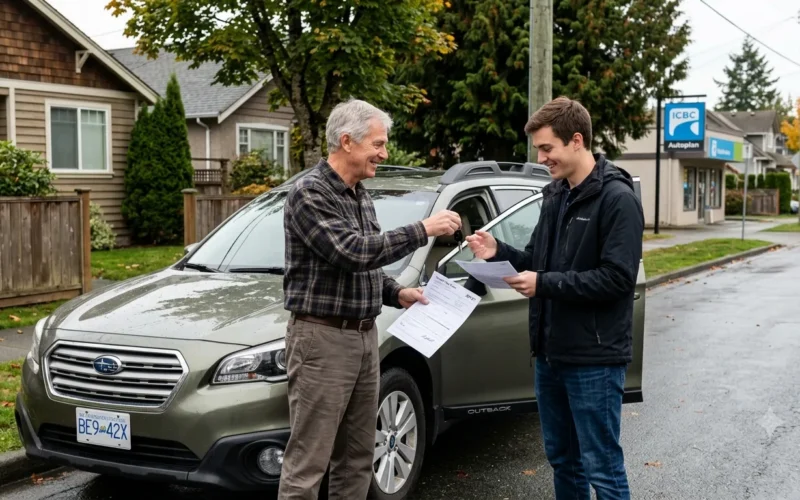
Buying a used vehicle in British Columbia can produce an unpleasant surprise: buying privately does not normally make the car tax-free.
In fact, for many ordinary used cars, the tax difference between buying privately and buying from a dealer is much smaller than buyers expect.
The “$1 bill of sale” trick does not work. For many private purchases, B.C. calculates PST using the greater of the declared purchase price or the Canadian Black Book average wholesale value.
Writing an artificially low number on the paperwork therefore does not normally reduce the tax bill.
There are, however, legitimate situations where PST can be reduced or avoided.
These include qualifying family gifts, inheritances, properly supported lower valuations, certain First Nations transactions and a particularly important exemption for new B.C. residents bringing a vehicle they already owned before moving.
What Taxes Apply When Buying a Used Car in B.C.?
The two taxes buyers usually need to distinguish are Provincial Sales Tax (PST) and the federal Goods and Services Tax (GST).
GST/HST generally does not apply when a vehicle is purchased privately from someone who is not a GST/HST registrant. That does not make the transaction tax-free, however, because the province can impose its own vehicle tax when the vehicle is registered.
Do You Pay PST on Used Cars in B.C.?
Yes, in most cases.
For privately acquired vehicles, ICBC says PST is generally calculated using the purchase price or Canadian Black Book average wholesale value, whichever is greater.
Suppose someone buys a used SUV privately for $8,000, but its applicable Canadian Black Book average wholesale value is $11,000.
If the normal 12% private-sale rate applies:
| Calculation | Amount |
| Actual purchase price | $8,000 |
| Wholesale value used for tax | $11,000 |
| PST at 12% | $1,320 |
| Purchase price + PST | $9,320 |
The buyer therefore cannot normally reduce PST simply by declaring a price below the vehicle’s recognized wholesale value.
Do You Pay GST on Used Cars in B.C.?
It depends on the seller.
The CRA states that GST/HST does not generally apply to a private sale where the seller is not a GST/HST registrant. When a vehicle is purchased from a dealership or another GST/HST registrant, GST/HST generally applies.
| Seller | GST | B.C. PST |
| Private non-registrant | Usually no | Usually yes |
| Dealer/GST registrant | Usually 5% GST | Usually yes |
| Qualifying family gift | Generally no sale for GST purposes | May be exempt |
| Estate distribution | Depends on circumstances, but ordinary purchase GST is generally not the issue | PST exemption may apply |
The CRA’s current explanation is available through its GST/HST and motor vehicles guidance.
What Are the Current B.C. PST Rates on Used Vehicles?
The rate depends on the value and classification of the vehicle and how it was acquired.
Non-ZEV Passenger Vehicles
| Purchase price or applicable value | Private sale / taxable private gift | GST registrant / taxable gift from GST registrant / imported into Canada / leased |
| Less than $55,000 | 12% | 7% |
| $55,000–$55,999.99 | 12% | 8% |
| $56,000–$56,999.99 | 12% | 9% |
| $57,000–$124,999.99 | 12% | 10% |
| $125,000–$149,999.99 | 15% | 15% |
| $150,000+ | 20% | 20% |
For non-ZEV non-passenger vehicles, ICBC states that a private sale or taxable gift is generally taxed at 12%, while vehicles purchased from a GST registrant, imported into Canada or leased generally use a 7% PST rate.
ZEV Passenger Vehicles
Zero-emission passenger vehicles use different lower-band thresholds:
| Purchase price or applicable value | Private sale / taxable gift | GST registrant / imported / leased |
| $0–$74,999.99 | 12% | 7% |
| $75,000–$75,999.99 | 12% | 8% |
| $76,000–$76,999.99 | 12% | 9% |
| $77,000–$124,999.99 | 12% | 10% |
| $125,000–$149,999.99 | 15% | 15% |
| $150,000+ | 20% | 20% |
ICBC identifies battery-electric vehicles, hydrogen fuel-cell vehicles and approved plug-in hybrid electric vehicles (PHEVs) as qualifying ZEV types for these rules.
Important hybrid distinction: a normal hybrid or HEV is not treated as a zero-emission vehicle for B.C. PST purposes. An approved PHEV may qualify as a ZEV, but an ordinary non-plug-in hybrid does not.
The current tables can be checked directly on the ICBC PST on vehicles page.
When and Where Do You Actually Pay PST on a Used Car?
This is an important practical detail.
For a private vehicle purchase, PST is generally collected by the Autoplan broker when the buyer registers the vehicle. It is not normally handed to the private seller as part of the sale price.
ICBC recommends completing the transfer promptly and states that newly purchased vehicles must generally be registered in the new owner’s name at an Autoplan broker within 10 days of purchase.
If registration is delayed, ICBC warns that the buyer may instead be required to pay the PST directly to the B.C. Ministry of Finance. Delaying registration is therefore not a way to make the tax disappear.
The buyer and seller normally complete the Transfer/Tax Form and provide the seller’s signed registration when completing the ownership transfer.
What Is the B.C. Luxury Car Tax?
What people often call the B.C. luxury car tax is generally the higher provincial PST rate applied to expensive passenger vehicles.
For applicable passenger vehicles, the PST rate reaches:
| Vehicle value | PST rate |
| $125,000–$149,999.99 | 15% |
| $150,000+ | 20% |
These provincial rates are separate from Canada’s federal luxury tax.
What Is Canada’s Federal Luxury Tax on Cars?
Canada’s Select Luxury Items Tax can apply to certain vehicles priced or valued above $100,000.
Broadly, the tax is calculated as the lesser of 10% of the taxable amount or 20% of the amount above $100,000.
There is an important exception for used cars.
The CRA states that, in most cases, the luxury tax does not apply to the sale of a qualifying subject vehicle that has already been registered with the Government of Canada or a province.
That means a $130,000 previously registered used luxury vehicle may escape the federal luxury tax but can still face B.C.’s 15% PST rate.
The detailed federal rules are available from the CRA’s subject vehicles luxury tax guidance.
Legal Ways to Reduce or Avoid Used Car Tax in B.C.
1. Buy Privately to Avoid GST — But Not PST
A private seller who is not a GST/HST registrant generally does not charge GST.
But B.C. PST will normally still apply.
Myth: “A private car sale saves all the tax.”
Reality: for many ordinary vehicles, it saves little or nothing in sales tax.
Consider a $25,000 non-ZEV passenger vehicle:
| $25,000 vehicle | Private seller | B.C. dealer |
| Purchase price | $25,000 | $25,000 |
| GST | $0 | $1,250 |
| PST | $3,000 at 12% | $1,750 at 7% |
| Total before other fees | $28,000 | $28,000 |
So, purely from the tax calculation, a $25,000 private sale can produce the same $3,000 total tax burden as the combined 5% GST and 7% PST on a dealer purchase.
The private car might still be cheaper because of its selling price, dealer fees or other factors—but “private sale means no tax” is simply incorrect.
2. Use a Genuine Trade-In
Where the applicable rules are satisfied, a vehicle accepted as a trade-in can reduce the taxable purchase-price amount.
For example:
| Transaction | Amount |
| Replacement vehicle | $30,000 |
| Eligible trade-in | -$10,000 |
| Net amount before applicable tax treatment | $20,000 |
The transaction needs to be genuine and properly documented. Buyers should ask the dealer or B.C. Ministry of Finance how the trade-in affects both PST and GST in their specific transaction rather than assuming the treatment is identical for every tax.
3. Use an Appraisal When the Wholesale Value Is Too High
Canadian Black Book values are useful for preventing artificial under-reporting, but a standardized valuation may not reflect a badly damaged or unusually worn vehicle.
Where the vehicle’s actual value is lower, B.C. provides a formal appraisal process.
A buyer may use FIN 320: Motor Vehicle Appraisal where appropriate.
If both the appraised value and purchase price are below the normal average wholesale value, the applicable PST calculation can use the greater of the appraised value and actual purchase price instead of the higher standard wholesale figure.
This can matter where a car has significant collision damage, mechanical defects, abnormal mileage or other condition problems.
The supporting form is listed by the B.C. government on its provincial sales tax forms page.
4. Claim a Genuine Related-Family Gift Exemption
A genuine transfer between qualifying related individuals can qualify for a PST exemption where the requirements are satisfied.
B.C. provides FIN 319 — Gift of a Vehicle for eligible transfers.
The key word is gift. Calling a transaction a gift does not make it one.
If the recipient pays money, takes over a debt or provides other consideration as part of the arrangement, different tax treatment may apply.
Buyers should therefore document genuine family gifts correctly rather than entering an artificially low purchase price.
5. Check the Estate or Inheritance Exemption
A vehicle received through the distribution of a deceased person’s estate may qualify for a PST exemption.
B.C.’s legislation specifically provides an exemption for tangible personal property transferred as part of the distribution of a deceased individual’s estate.
The estate documentation should therefore be reviewed before PST is paid as though the transaction were an ordinary private sale.
6. Check First Nations PST Rules
A qualifying First Nations individual or band may be entitled to a PST exemption where the statutory location, purchaser and transaction requirements are satisfied.
Vehicle transactions can involve additional documentation and delivery requirements, so buyers should confirm the circumstances with the B.C. Ministry of Finance or Autoplan broker rather than assuming status alone automatically makes every vehicle purchase exempt.
7. Stay Below a Higher B.C. PST Threshold
For an expensive passenger vehicle, crossing a PST threshold can materially change the tax.
For example, applicable passenger vehicles valued at $125,000 or more can move into the 15% rate, while those valued at $150,000 or more can reach 20%.
Choosing a less expensive vehicle is therefore a completely legitimate way of avoiding the higher B.C. luxury-vehicle PST bands.
8. Do Not Assume Buying in Alberta Avoids B.C. PST
Alberta has no provincial sales tax.
That makes Alberta attractive to some vehicle shoppers, but it does not mean a B.C. resident can buy a car there, drive it home and automatically avoid B.C. PST.
The B.C. Provincial Sales Tax Act contains rules for vehicles purchased outside British Columbia and subsequently brought, sent or delivered into B.C.
So the key question is not simply “Where did I buy it?” It is also “Where will it be registered and used?”
Buying in Alberta solely to exploit Alberta’s lack of provincial sales tax should therefore not be treated as a B.C. tax loophole.
9. New Residents Can Bring Certain Already-Owned Vehicles Into B.C. PST-Free
This is an important exemption and is fundamentally different from a B.C. resident travelling to Alberta to buy a vehicle.
A person becoming a new resident of British Columbia can bring certain personal property—including a motor vehicle—into B.C. without paying PST if the statutory requirements are satisfied.
For a vehicle, the key conditions are that it is brought into B.C. solely for non-business use, the person owned it continuously for at least 30 days before becoming a B.C. resident, and it enters B.C. within one year after the person becomes a resident.
Example
Priya lives in Alberta and owns her car for two years. She then permanently moves to Vancouver and brings the same personal-use car with her a month later.
Because she owned the vehicle well before becoming a B.C. resident and brought it into the province within the permitted period for personal use, the new-resident PST exemption may apply.
Now compare that with another person who moves to Vancouver, becomes a B.C. resident, then drives to Alberta two months later and buys a car.
That is a purchase made after becoming a B.C. resident, not a vehicle already owned before the move. The new-resident exemption does not turn that later Alberta purchase into a tax-free vehicle.
B.C. says previous registration or a bill of sale can be used to establish the required ownership period, and evidence showing when the person became a B.C. resident may also be requested.
People moving into the province will also need to deal with vehicle, licence and insurance records. The site’s ICBC address change and moving requirements cover the practical ICBC side of changing residence.
Are Used Electric and Hybrid Cars PST-Free in B.C.?
Not anymore.
British Columbia previously exempted qualifying used zero-emission vehicles from PST, but the provincial government ended that exemption effective May 1, 2025.
The previous exemption could apply to qualifying vehicles purchased, leased or gifted before that date.
The important distinction in 2026 is:
| Vehicle | Treated as ZEV for B.C. PST purposes? |
| Battery-electric vehicle (BEV) | Yes |
| Hydrogen fuel-cell vehicle | Yes |
| Approved plug-in hybrid (PHEV) | Yes |
| Standard/non-plug-in hybrid (HEV) | No |
ICBC explicitly states that conventional HEVs are not zero-emission vehicles for these PST rules.
So someone searching for a “hybrid tax exemption in B.C.” should not assume that buying a Toyota-style conventional hybrid gives them ZEV tax treatment.
How Does Used-Car Tax in B.C. Compare With Alberta, Saskatchewan and Ontario?
The provinces treat private used-car purchases very differently.
| Province | Typical private used-vehicle treatment | Typical dealer tax structure |
| British Columbia | Generally 12% PST below the higher-value bands | Generally 5% GST + B.C. PST; PST starts at 7% for lower-value non-ZEV passenger vehicles |
| Alberta | No provincial sales tax; private non-registrant sale generally has no GST | 5% GST generally applies; no provincial sales tax |
| Saskatchewan | 6% PST generally applies; private used vehicles can qualify for a $5,000 exemption where both purchase price and applicable Red Book value are $5,000 or less | Generally 5% GST + 6% PST |
| Ontario | Private transactions generally attract 13% RST, normally based on purchase price or wholesale value, whichever is greater | Generally 13% HST |
Alberta’s government confirms that the province has no provincial sales tax. Saskatchewan currently charges 6% PST and its vehicle bulletin provides the $5,000 private-sale exemption described above.
Ontario says private specified-vehicle purchases generally attract 13% RST and that the buyer pays it when registering the vehicle rather than paying it to the private seller.
Does This Mean Buying a Car in Alberta Is Tax-Free?
Only in the limited sense that Alberta itself does not impose provincial sales tax.
An Alberta resident buying privately and registering the vehicle there may have a very different tax result from a B.C. resident purchasing the same vehicle and taking it back to British Columbia.
Therefore, “Alberta has no PST” and “a B.C. resident can avoid B.C. PST by shopping in Alberta” are not the same statement.
Private Sale vs Dealer: Which Actually Has Less Tax?
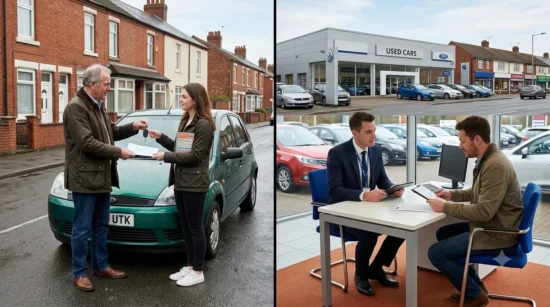
The answer depends on the value of the vehicle.
For a standard non-ZEV passenger vehicle below $55,000:
Private purchase: 12% PST, generally no GST if the seller is not a registrant.
Dealer purchase: 7% PST plus 5% GST.
That gives the same nominal 12% combined tax rate before considering trade-ins, dealer fees and other transaction-specific factors.
At higher values, the comparison changes because B.C.’s dealer/GST-registrant PST rate moves through 8%, 9% and 10% bands before both acquisition types reach 15% at $125,000.
Price alone should therefore be compared on an all-in basis, rather than assuming the private seller automatically produces the lowest tax cost.
Worked Used-Car Tax Examples
Example 1: $25,000 Private SUV
The buyer purchases a non-ZEV passenger SUV privately for $25,000 and the Canadian Black Book value does not exceed the purchase price.
PST: $25,000 × 12% = $3,000
Total before registration, insurance and other costs: $28,000
No GST generally applies where the private seller is not a GST/HST registrant.
Example 2: $25,000 SUV From a Dealer
Purchase price: $25,000
GST at 5%: $1,250
B.C. PST at 7%: $1,750
Total tax: $3,000
Total before other charges: $28,000
For this example, the private and dealer tax totals are identical.
Example 3: $42,000 Dealer Used SUV
Purchase price: $42,000
GST at 5%: $2,100
PST at 7%: $2,940
Combined tax: $5,040
Total: $47,040
This calculation excludes registration, insurance, financing, optional products and other dealer charges.
If financing is required, the interest cost can sometimes be more significant than a small difference in tax or purchase price. Buyers facing credit problems can compare those wider costs in the site’s article on bad-credit car loans in Canada.
Example 4: $130,000 Previously Registered Luxury Vehicle
Assume a previously registered non-ZEV passenger vehicle is worth $130,000.
At this level, B.C. PST is 15%.
A private acquisition subject to the 15% rate produces:
$130,000 × 15% = $19,500 PST
If purchased from a GST registrant, 5% GST would also generally equal $6,500, producing $26,000 of combined GST and PST before other charges.
Because the car has already been registered with a Canadian government, the federal luxury tax would generally not apply, subject to the specific statutory exceptions.
Example 5: Vehicle Bought for $8,000 but Valued at $11,000
Purchase price: $8,000
Average wholesale value: $11,000
PST base: $11,000
PST at 12%: $1,320
If the car is genuinely worth less because of severe mechanical or physical problems, the buyer may want to investigate the FIN 320 appraisal process rather than simply declaring a lower sale price.
What Should Used-Car Buyers Never Do?
Buyers should not artificially reduce the bill-of-sale amount, disguise a purchase as a family gift, invent a trade-in, provide false appraisal information or assume that delaying ICBC registration eliminates PST.
They should also avoid assuming that every hybrid qualifies as a ZEV, every used EV remains PST-exempt, every Alberta purchase avoids B.C. tax or every used luxury vehicle is free from all luxury-related taxes.
B.C.’s valuation rules and registration process are specifically designed to prevent a nominal sale price from automatically determining the tax bill.
Used-Car Tax Checklist Before You Buy
| Question | Why it matters |
| Is the seller private or a GST registrant? | Determines whether GST generally applies |
| What is the purchase price? | Used in calculating PST |
| What is the Canadian Black Book value? | May become the taxable value for a private purchase |
| Is the vehicle damaged or unusually worn? | A legitimate appraisal may help |
| Is there a trade-in? | May affect the taxable amount |
| Is the transfer a genuine qualifying family gift? | A PST exemption may apply |
| Was the vehicle inherited? | Estate exemption may apply |
| Is the buyer a new B.C. resident? | Previously owned vehicle may qualify for exemption |
| Was the vehicle already owned for 30+ days before moving? | Critical new-resident condition |
| Is it an HEV, PHEV, BEV or FCEV? | ZEV classification affects thresholds |
| Is the vehicle worth $125,000+? | Higher B.C. PST bands apply |
| Was an expensive used vehicle previously registered? | Relevant to federal luxury-tax treatment |
| Was it purchased outside B.C.? | B.C. tax can still apply |
| Are the correct forms ready? | Needed to support exemptions or valuations |
| Has registration been arranged promptly? | New purchases generally must be registered within 10 days |
FAQs About Used Car Tax in B.C.
How do I avoid paying tax on a used car in B.C.?
There is no general exemption for ordinary used-car purchases. PST can legally be avoided only where a valid exemption applies, such as certain family gifts, inheritances, qualifying First Nations transactions or qualifying property brought into B.C. by a new resident.
Is a private used-car sale tax-free in B.C.?
No. GST generally does not apply to a private non-registrant sale, but B.C. PST normally does.
How much PST is charged on a private used car in B.C.?
The general private-sale rate is 12%, rising to 15% for applicable passenger vehicles valued at $125,000–$149,999.99 and 20% at $150,000 or more.
Is PST based on what I actually paid for the car?
Not always. For many private acquisitions, it is based on the greater of the purchase price and the Canadian Black Book average wholesale value.
Can I put $1 on the bill of sale?
Putting an artificially low price on the form generally does not eliminate PST because B.C. can use the vehicle’s wholesale value instead.
Where do I pay PST on a private used-car purchase?
PST is generally collected through an Autoplan broker when the vehicle is registered. If registration is delayed, ICBC says tax may have to be paid directly to the B.C. Ministry of Finance.
How quickly must I register a used vehicle?
ICBC states that a newly purchased vehicle generally must be registered in the licence holder’s name at an Autoplan broker within 10 days of purchase.
Can I buy a car in Alberta to avoid B.C. PST?
Buying in Alberta does not automatically remove B.C. tax if the vehicle is subsequently brought into British Columbia for use by a B.C. resident. Alberta’s lack of provincial sales tax should not be confused with a B.C. PST exemption.
Can a new resident bring their car into B.C. without PST?
Potentially yes. The vehicle generally must have been owned continuously for at least 30 days before the person became a B.C. resident, be brought into B.C. within one year of becoming resident and be brought in solely for non-business use.
Are hybrid cars exempt from PST in B.C.?
Ordinary non-plug-in hybrids are not considered ZEVs for B.C. PST purposes. Approved PHEVs, BEVs and hydrogen fuel-cell vehicles can fall within the ZEV classification.
Are used electric cars PST-free in B.C. in 2026?
No general used-ZEV exemption remains. B.C. ended the exemption effective May 1, 2025.
Can a family member give me a car tax-free?
A genuine vehicle gift from an eligible related individual may qualify for a PST exemption if all requirements are met. B.C. provides FIN 319 for qualifying vehicle gifts.
Does Canada’s federal luxury tax apply to used cars?
In most cases, it does not apply when the subject vehicle has already been registered with the Government of Canada or a province. B.C. PST can still apply.
What forms might be needed?
Depending on the circumstances, common B.C. forms include FIN 319 for a vehicle gift and FIN 320 for a motor-vehicle appraisal. The exact evidence required depends on the exemption or adjustment being claimed.