


Table of Contents Show
Last Updated: 15.10.2026
Ontario’s G1 licence is the first stage of the province’s graduated licensing system for new Class G drivers. It allows beginners to gain real driving experience under supervision before progressing to a G2 licence and eventually a full G licence.
In 2026, applicants must be at least 16 years old, live in Ontario, pass a vision test and pass the G1 knowledge test.
Once a G1 licence is issued, the driver can practise on Ontario roads, but only while following strict conditions designed to reduce the risks associated with inexperienced driving.
Several important changes also took effect in 2026, particularly for residency declarations and drivers bringing previous experience from countries without licence-exchange agreements.
When Was The G1 Licence Introduced In Ontario?
Ontario introduced its Graduated Licensing System in 1994, becoming the first jurisdiction in North America to introduce a comprehensive graduated licensing program for novice drivers.
The first stage began on April 1, 1994, when new driver applicants started entering the graduated system. A further stage of implementation followed on June 6, 1994, bringing existing learner drivers who had not completed their road test into the new system.
The purpose was straightforward. Instead of giving a new driver almost unrestricted driving privileges after one test, Ontario introduced stages that allow drivers to develop experience gradually.
The system created what are now familiar as the G1, G2 and full G stages.
G1 Licence Timeline: How Ontario’s Graduated Licensing System Has Changed?
Ontario’s graduated licensing system has remained based on the same fundamental idea since the 1990s, although individual requirements have changed over time.
| Period | Development |
| 1994 | Ontario introduces graduated licensing for new drivers |
| 1994 onward | New drivers progress through supervised and independent novice stages before earning a full G licence |
| Later years | Additional novice-driver safety rules and escalating sanctions are introduced |
| May 11, 2026 | New G and M applicants must make declarations concerning Ontario residency and legal presence in Canada |
| July 1, 2026 | New limits take effect on the amount of driving experience applicants from non-exchange jurisdictions can claim |
| 2026 | G1, G2 and full G continue to form Ontario’s standard graduated Class G licensing pathway |
The basic system has therefore lasted for more than three decades. What has changed most is how Ontario verifies applicants, treats foreign driving experience and handles violations by novice drivers.
How Is The G1 Licensing System Working In 2026?
In 2026, the G1 remains the learner stage of Ontario’s Class G licensing system.
A person begins by passing the required knowledge and vision tests. After receiving the G1, they practise with an eligible accompanying driver before taking the first road test to progress to G2.
The standard G1 stage lasts 12 months. Completing a Ministry-approved beginner driver education course can reduce the waiting period to eight months. Ontario’s regulation technically sets those periods at 365 days and 245 days respectively.
After passing the G2 road test, the driver enters Level Two and gains substantially more independence. A further road test is eventually required to obtain a full G licence.
Anyone preparing for the practical stage should also understand how an Ontario road test operates.
The process can vary by location, and preparation for an Oshawa DriveTest, for example, involves vehicle preparation, documentation and demonstrating safe driving skills during the examination.
What Are The G1 Licensing Rules In Ontario For 2026?
Holding a G1 does not give a driver the same privileges as a full G licence.
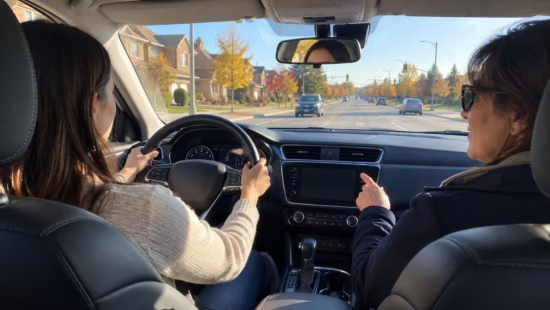
A G1 driver must follow several important conditions whenever operating a vehicle.
- Accompanying Driver: A qualified fully licensed driver must sit in the front passenger seat
- Driving Experience: The accompanying driver generally needs at least four years of driving experience
- Alcohol: The G1 driver’s blood alcohol concentration must remain zero
- Night Driving: G1 drivers cannot drive between midnight and 5 a.m.
- Highways: Driving on designated high-speed expressways is generally prohibited
- Seat Belts: Every person in the vehicle must have a properly functioning seat belt
- Supervision: A G1 driver cannot legally drive alone
These restrictions apply even when the journey is short. Driving a few blocks to work, school or a shop does not create an exception to the supervision requirement.
G1 Licence Rules At A Glance
| Requirement | G1 Rule |
| Minimum Age | 16 |
| Vision Test | Required |
| Knowledge Test | Required |
| Supervising Driver | Required |
| Minimum Supervising Experience | At least 4 years |
| G1 Driver BAC | Zero |
| Driving Midnight To 5 a.m. | Not permitted |
| Designated High-Speed Highways | Generally not permitted |
| Normal G1 Waiting Period | 12 months |
| With Approved Driver Education | About 8 months |
| Licence Validity | Up to 5 years |
Ontario regulations provide for a qualified applicant to receive a G1 licence that is valid for five years.
Who Can Apply For A G1 Licence?
A new Ontario driver generally needs to meet four main requirements.
- Be At Least 16 Years Old
- Be An Ontario Resident
- Pass A Vision Test
- Pass The Knowledge Test
Applicants must also provide acceptable original identification showing their legal name and date of birth.
Since May 11, 2026, people applying for a Class G or M licence must also declare that Ontario is their primary place of residence and that their presence in Canada is legal.
This is an important 2026 update because older G1 guides may not mention the declaration requirement.
How Do You Get A G1 Licence In Ontario?
The process is considerably simpler than some older online guides suggest.
First, prepare for the knowledge examination by studying Ontario road signs, traffic laws and safe-driving requirements.
Then visit an appropriate testing location with acceptable identification. Knowledge tests are available at DriveTest centres, while the ServiceOntario Bay and College location in downtown Toronto also provides testing by appointment.
You will then complete the required vision and knowledge tests.
If you pass both, you can receive your G1 licence and begin supervised driving.
You do not need to pass a road test to obtain the initial G1 licence. The first road test comes later when you are ready to progress from G1 to G2.
Driver education is also not mandatory simply to obtain a G1. However, completing an approved beginner driver education course can reduce the minimum G1 waiting period.
Who Can Accompany A G1 Driver?
A G1 driver must have an eligible supervising driver sitting beside them in the front passenger seat.
The accompanying driver must normally:
- Hold A Full Licence: They must hold an appropriate full driver’s licence
- Have Enough Experience: They need at least four years of driving experience
- Sit Beside The G1 Driver: They must occupy the front passenger seat
- Meet Alcohol Requirements: Their blood alcohol concentration must remain within the legal G1 supervising-driver limit
- Remain Capable Of Supervising: They must be able to provide assistance and instruction when necessary
A G2 licence holder cannot simply supervise a G1 driver because G2 is still a novice licence rather than a full G licence.
The supervising driver also does not need to own the vehicle. What matters is their licence status, experience and ability to meet the required conditions.
Where And When Can A G1 Driver Drive?
A G1 driver can practise on many Ontario roads when an eligible accompanying driver is present.
Residential roads, ordinary urban streets and many lower-speed highways can therefore form part of the learning process.
However, two major restrictions apply.
Can A G1 Driver Drive At Night?
A G1 driver cannot drive between midnight and 5 a.m.
This restriction applies regardless of whether an experienced driver is sitting beside them.
A learner could therefore practise during the evening but must ensure they are no longer driving when the restricted period begins.
Can A G1 Driver Drive On 400-Series Highways?
G1 drivers generally cannot drive on designated high-speed roads including major 400-series highways and certain expressways.
Restrictions cover roads such as Highway 401, Highway 400, Highway 404, Highway 407, Highway 410, Highway 427 and the Queen Elizabeth Way, along with other designated expressways.
There is an important exception. A G1 driver may use otherwise prohibited highways when accompanied by a qualified Ontario driving instructor under the applicable rules.
This gives learners the opportunity to gain controlled expressway experience with professional supervision.
How Many Passengers Can A G1 Driver Carry?
G1 passenger rules are frequently misunderstood.
There is not a simple rule stating that every G1 driver can carry only two or three passengers. Instead, the vehicle must meet the supervision and seat-belt conditions that apply to a G1 driver.
The qualified accompanying driver must occupy the front passenger seat, and every passenger must have a functioning seat belt.
This means the practical passenger capacity depends partly on the vehicle’s legally available seating and seat belts.
Children and teenagers are not automatically prohibited from travelling with a G1 driver. Appropriate child-seat, seat-belt and G1 supervision requirements still apply.
What Happens If A G1 Driver Breaks The Rules?
G1 holders are novice drivers and can face stronger consequences than fully licensed drivers for certain violations.
Ontario’s novice-driver demerit system currently operates as follows:
| Demerit Points | Consequence For A Novice Driver |
| 2 To 5 | Warning letter |
| 6 To 8 | Second warning letter |
| 9 Or More | 60-day licence suspension |
Ontario also uses escalating sanctions for novice drivers who violate graduated licensing conditions or commit certain serious offences.
Drivers wanting to understand how individual offences affect their record should also know how demerit points in Ontario work because G1 and G2 drivers face different thresholds from fully licensed motorists.
Following the restrictions is therefore important not only for safety but also for keeping the graduated licensing process on track.
How Long Do You Stay At The G1 Level Before Moving To G2?
Most new drivers must remain at the G1 level for 12 months before becoming eligible to take the G2 road test.
There is one major way to shorten that period.
If the driver successfully completes a Ministry-approved beginner driver education course, Level One can be reduced to approximately eight months.
Once eligible, the learner must pass the Level One road test. Passing moves the driver into the G2 stage.
The driver does not automatically receive G2 simply because the waiting period has ended.
How Is A G1 Licence Different From G2 And A Full G Licence?
The three licences represent different levels of driving independence.
A G1 is primarily a supervised learner licence.
A G2 allows a person to drive independently but still classifies them as a novice driver and leaves certain novice restrictions in place.
A full G licence represents completion of Ontario’s graduated Class G licensing process.
The biggest change from G1 to G2 is independence. Once a driver receives G2, they no longer need an experienced fully licensed driver sitting beside them for ordinary driving.
G1 Vs G2 Vs Full G Licence Comparison
| Feature | G1 | G2 | Full G |
| Beginner Licence | Yes | Yes | No |
| Can Drive Alone | No | Yes | Yes |
| Supervising Driver Required | Yes | No | No |
| Midnight To 5 a.m. G1 Restriction | Yes | No General G1 Curfew | No |
| Designated Highway Restriction | Yes | Generally No | No |
| Novice Driver Status | Yes | Yes | No |
| Road Test Needed To Progress | Yes | Yes | N/A |
| Final Stage | No | No | Yes |
The G1 therefore differs substantially from the other licence levels because it is designed around supervised learning rather than independent driving.
What Changed For G1 Applicants In 2026?
Two changes deserve particular attention in 2026.
The first took effect on May 11, 2026. Class G and M applicants now have to declare that Ontario is their primary residence and that their presence in Canada is legal.
The second change took effect on July 1, 2026 and affects applicants with driving experience from jurisdictions that do not have a licence-exchange agreement with Ontario.
These applicants can receive credit for up to 12 months of qualifying previous driving experience. Ontario says only eligible experience within the preceding three years can be credited, up to that 12-month maximum.
For example, a qualifying applicant with at least 12 months of credited foreign experience may be eligible to take the G2 road test immediately. Different requirements apply depending on how much experience can be proven and whether an authentication letter is required.
This is particularly important for newcomers because older online guides may describe different foreign-experience rules.
What Future Updates Could Affect G1 Licensing In Ontario?
Ontario continues to amend its driver-licensing regulations, so future applicants should verify the current rules before testing.
As of October 2026, the core G1 progression remains in place. A new driver still begins at G1, completes supervised learning, progresses to G2 through a road test and later moves toward a full G licence.
The major 2026 G1-related developments have concerned residency verification and foreign driving-experience credits rather than replacing the G1 system itself.
Ontario has made other driver-licensing changes for 2027, including changes affecting progression toward certain commercial licences, but those should not be confused with a general removal or replacement of the G1 stage.
Future changes could still affect testing, documentation, novice-driver enforcement or licence recognition. For that reason, applicants should confirm requirements with Ontario or DriveTest when their testing date approaches.
What Happens If A G1 Licence Expires?
A G1 licence is generally issued with a five-year validity period.
That gives drivers time to move through the graduated licensing system, but it should not be treated as unlimited time.
A driver should complete the required progression before the licence expires or determine whether they qualify for any applicable requalification process.
Waiting until the final weeks can create unnecessary problems, particularly if road-test availability is limited or the driver fails a test and needs another attempt.
Drivers should therefore monitor the expiry date printed on the licence throughout the G1 and G2 stages.
Does A G1 Driver Need Car Insurance?
A G1 driver normally does not purchase a completely separate auto insurance policy simply because they hold a learner licence.
However, the vehicle being driven must have valid Ontario automobile insurance, and the vehicle owner should tell their insurer about learner drivers where required.
Coverage arrangements can vary between households and insurers.
New drivers should therefore confirm how the learner will be treated under the vehicle owner’s policy rather than assuming they are automatically covered in every circumstance.
Insurance can also become a much larger expense after progressing to independent driving. Factors including age, location, vehicle, driving record and licence experience can affect car insurance costs in Ontario.
Conclusion
Ontario’s G1 licensing rules are designed to give beginner drivers time to gain experience without immediately receiving unrestricted driving privileges.
The system has existed since 1994 and remains the first stage of Ontario’s graduated licensing process in 2026.
G1 drivers must be supervised by an eligible fully licensed driver, maintain zero blood alcohol, avoid driving between midnight and 5 a.m., follow passenger and seat-belt rules and stay off designated high-speed highways unless an applicable driving-instructor exception applies.
The most notable 2026 developments include the new Ontario residency and legal-presence declarations introduced on May 11 and revised foreign-driving-experience rules that took effect on July 1.
Understanding these conditions before getting behind the wheel makes the transition from G1 to G2 much easier and helps new drivers avoid penalties that could delay their progress.
FAQs About G1 Licensing Rules
Can A G1 Driver Drive Alone?
No. A qualified fully licensed driver with the required driving experience must accompany a G1 driver and sit in the front passenger seat.
Can A G2 Driver Supervise A G1 Driver?
Generally, no. A G2 is still a novice licence. The accompanying driver must meet Ontario’s full-licence and driving-experience requirements.
Can A G1 Driver Drive Someone Else’s Car?
Yes, provided the vehicle is properly insured, the G1 driver has permission to use it and all G1 supervision and driving restrictions are followed.
Can A G1 Driver Carry Children?
Yes. Children are not automatically prohibited, but every applicable child-restraint, seat-belt, passenger and G1 supervision rule must be followed.
Can A G1 Driver Drive On Highway 401?
Generally, no. Highway 401 is one of the high-speed highways restricted for ordinary G1 driving. An applicable exception exists when the learner is driving with a qualified Ontario driving instructor.
Can A G1 Driver Drive Outside Ontario?
Do not assume an Ontario G1 automatically gives you permission to drive in another province, territory or country. Recognition of learner licences can vary by jurisdiction, so drivers should confirm the destination’s rules before travelling.
How Many Times Can You Take The G1 Test?
A failed knowledge test does not permanently prevent you from obtaining a G1. You can retake the required test, but another testing fee may apply. Preparing from the current Official MTO Driver’s Handbook can reduce the likelihood of repeated attempts.