



Table of Contents Show
Last Updated on 01.10.2026
Preparing with an M1 practice test can help new motorcycle riders understand the knowledge they need before applying for an Ontario M1 licence.
The real M1 knowledge test covers motorcycle safety, traffic signs, rules of the road, riding techniques and situations riders may encounter on Ontario roads.
Applicants must be at least 16 years old and must pass both a vision test and the required written knowledge testing before receiving an M1 licence.
Once issued, the M1 is valid for only 90 days, making it important to understand both the test and what comes next in Ontario’s graduated motorcycle licensing system.
What Is M1 Practice Test?
An M1 practice test is a study tool designed to help prospective motorcycle riders prepare for Ontario’s official motorcycle knowledge test.
Practice questions normally cover areas such as:
- Traffic Signs And Signals
- Motorcycle Controls
- Lane Position
- Rules Of The Road
- Safe Following Distance
- Riding On Difficult Surfaces
- Motorcycle Equipment
- Protective Equipment
- Carrying Passengers And Cargo
- Motorcycle Maintenance
- Hazard Awareness
- Safe Turning And Braking
The actual knowledge test uses multiple-choice questions. However, learners should avoid depending on a specific question count quoted by unofficial practice websites.
Ontario’s publicly available motorcycle licensing information focuses on the subjects applicants must understand rather than guaranteeing that every test will contain a particular number of questions.
What Are the Key M1 Licence Facts in 2026?
The following details are particularly important for anyone preparing for the test.
| M1 Requirement | Current Rule |
| Minimum Age | 16 |
| Vision Test | Required |
| Knowledge Test | Required |
| M1 Licence Validity | 90 Days |
| Minimum M1 Holding Period | 60 Days |
| Blood Alcohol Level | Zero |
| Passengers | Not Permitted |
| Riding Time | Daylight Hours Only |
| High-Speed Roads | Generally Restricted Above 80 km/h |
| Approved Helmet | Required, subject to the applicable legal exemption |
| M1 Licence Package | $78.75 |
| Knowledge Test Fee | $16.00 |
| 90-Day Licence Fee | $9.00 |
| M2 Road Test Fee | $53.75 |
The standard $78.75 Class M1 package includes the knowledge test, the M2 road test and the 90-day licence. Different fee arrangements apply to riders completing an approved motorcycle safety course.
Free M1 Practice Test Questions
These original practice questions cover some of the rules and safety concepts an Ontario motorcycle applicant should know.
1. How Old Must You Be to Apply for an M1 Licence?
A) 14
B) 15
C) 16
D) 18
Answer: C) 16
2. What Blood Alcohol Level Must an M1 Rider Maintain?
A) Below 0.08
B) Below 0.05
C) Zero
D) It depends on age
Answer: C) Zero
3. Can an M1 Rider Carry a Passenger?
A) Yes, during daylight
B) Yes, if the passenger has an M licence
C) Only on local roads
D) No
Answer: D) No
4. When Can an M1 Rider Normally Ride?
A) At any time
B) During daylight hours
C) Only before noon
D) Only on weekends
Answer: B) During daylight hours
5. How Long Is an M1 Licence Valid?
A) 30 days
B) 60 days
C) 90 days
D) One year
Answer: C) 90 days
6. How Long Must You Normally Hold an M1 Before Taking the Level One Road Test?
A) 30 days
B) 45 days
C) 60 days
D) 90 days
Answer: C) 60 days
7. Which Test Must Be Passed Along With the Knowledge Test?
A) Hearing test
B) Vision test
C) Fitness test
D) Motorcycle road test immediately
Answer: B) Vision test
8. What Should Riders Do Before Changing Lanes?
A) Accelerate immediately
B) Check mirrors and blind areas and signal appropriately
C) Sound the horn continuously
D) Move first and check afterwards
Answer: B) Check mirrors and blind areas and signal appropriately
9. Why Is Lane Position Important for Motorcyclists?
A) It can improve visibility and provide space to react
B) It allows riders to ignore traffic
C) It eliminates the need for mirrors
D) It permits higher speeds
Answer: A) It can improve visibility and provide space to react
10. What Should a Rider Do on a Slippery Surface?
A) Make sudden steering movements
B) Accelerate sharply
C) Use smooth, controlled inputs
D) Follow vehicles more closely
Answer: C) Use smooth, controlled inputs
11. Why Should Motorcyclists Leave Adequate Following Distance?
A) To create more time to react and stop
B) To prevent other vehicles from changing lanes
C) To travel faster
D) To avoid checking mirrors
Answer: A) To create more time to react and stop
12. What Is the Purpose of an Approved Motorcycle Helmet?
A) Decoration
B) Protection from weather only
C) Reducing the risk of head injury
D) Improving fuel economy
Answer: C) Reducing the risk of head injury
13. Should Motorcycle Riders Watch the Road Surface Ahead?
A) Only during rain
B) Only on highways
C) Yes, because gravel, oil, potholes and other hazards can affect traction
D) No, if traffic is light
Answer: C) Yes, because gravel, oil, potholes and other hazards can affect traction
14. What Is One Important Reason to Check Your Motorcycle Before Riding?
A) To identify possible mechanical or safety problems
B) To shorten the licensing period
C) To remove the helmet requirement
D) To increase the speed limit
Answer: A) To identify possible mechanical or safety problems
15. What Should a Rider Do When Approaching an Unfamiliar Hazard?
A) Increase speed
B) Maintain awareness and prepare to react safely
C) Follow the vehicle ahead more closely
D) Ignore it unless another rider stops
Answer: B) Maintain awareness and prepare to react safely
Which Topics Should You Study Most Carefully?
A strong M1 practice test should cover more than simple road-sign recognition. Motorcycle-specific knowledge is a major part of effective preparation.
Lane Position And Space Management
A motorcycle occupies less road space than a car, but that does not mean riders should surrender their lane position.
Riders need to understand how positioning affects visibility, escape space and the ability of other road users to see them.
Dangerous Road Surfaces
Loose gravel, wet pavement, railway tracks, potholes, painted surfaces and other changing conditions can affect motorcycle traction. Smooth braking, steering and acceleration become particularly important when grip is reduced.
Motorcycle Controls
Applicants should understand basic motorcycle controls and how braking, steering, shifting and acceleration affect the motorcycle.
Traffic Signs And Rules
M1 applicants should also study Ontario traffic signs, signals, right-of-way rules and general road regulations rather than concentrating exclusively on motorcycle-specific questions.
Protective Equipment
A helmet is a legal requirement for motorcycle riders in Ontario, subject to the applicable exemption under provincial law.
Appropriate protective clothing, footwear, gloves and eye protection can also help reduce exposure to injuries and road debris.
How Should You Prepare for the M1 Test?
Simply completing the same M1 practice test repeatedly can lead to memorising answers rather than understanding the rules.
A better preparation method is:
- Read The Motorcycle Handbook: Study motorcycle controls, riding techniques, lane positioning, equipment and hazard management.
- Review General Road Rules: Traffic signs, signals and basic road rules are also part of the knowledge required.
- Take Practice Tests: Use different questions instead of repeating only one quiz.
- Review Every Wrong Answer: Return to the relevant topic whenever you make a mistake.
- Practise By Topic: Separate road signs, motorcycle controls, road rules and hazard questions until weak areas improve.
- Take A Final Mixed Test:Once individual topics are comfortable, complete mixed practice questions without referring to notes.
What Should You Bring on M1 Test Day?
Applicants should prepare before visiting the test centre.
Bring:
- Original Accepted Identification
- Payment For The Required Fees
- Glasses Or Contact Lenses If Normally Required
- Any Other Documentation Required For Your Circumstances
Applicants must provide identification establishing the required personal information. As of May 11, 2026, applicants for a Class M licence must also declare that Ontario is their primary place of residence and that their presence in Canada is legal.
The vision and knowledge tests are completed before the M1 licence is issued.
What Happens After You Pass the M1 Test?
Passing the written test does not result in a separate practice-test certificate.
Once the required knowledge and vision testing has been successfully completed and the licensing requirements are satisfied, the applicant receives an M1 licence.
The rider then enters Level One of Ontario’s graduated motorcycle licensing system.
The M1 remains valid for 90 days. A rider must normally remain at the M1 level for at least 60 days before attempting the first motorcycle road test.
Passing that road test allows the rider to progress to M2.
What Restrictions Apply While You Have an M1?
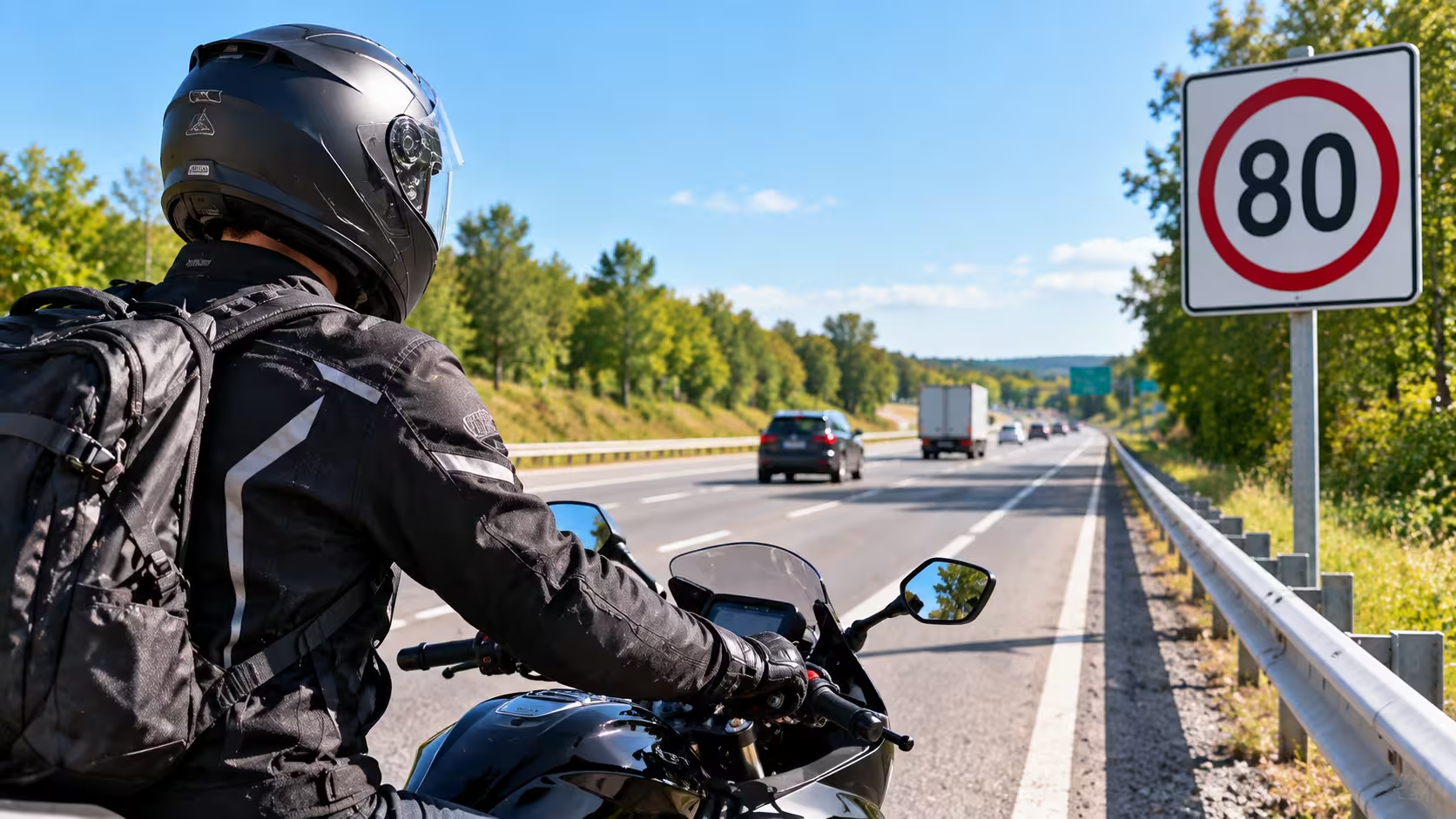
M1 riders face stricter conditions because they are still beginner motorcyclists.
They must:
- Maintain Zero Blood Alcohol
- Ride Only During Daylight Hours
- Ride Without Passengers
- Follow The M1 High-Speed Road Restrictions
- Wear An Approved Motorcycle Helmet, Subject To The Legal Exemption
M1 riders generally cannot use roads where the speed limit exceeds 80 km/h. However, specific sections of Highways 11, 17, 61, 69, 71, 101, 102, 144 and 655 are exceptions.
Knowing these restrictions is useful for both the knowledge test and real-world riding after obtaining the licence.
How Does the M1 to M2 to M Process Work?
Ontario uses graduated licensing to give new riders time to develop practical skills.
Stage 1: M1
Pass the vision and knowledge tests. The M1 is valid for 90 days and must normally be held for at least 60 days.
Stage 2: M2
Pass the Level One motorcycle road test or complete the appropriate approved motorcycle safety course requirements.
M2 riders have fewer restrictions than M1 riders but remain novice motorcycle drivers.
Stage 3: Full M Licence
After meeting the required Level Two waiting period and passing the final motorcycle road test, riders can progress to a full Class M licence.
Completing a ministry-approved motorcycle safety course can affect the licensing pathway. Riders who successfully complete an approved course must apply for their upgraded licence within six months of completing it.
How Can You Avoid Common M1 Test Mistakes?
Many mistakes come from memorising individual answers rather than understanding the underlying rule.
Try to avoid:
- Ignoring Motorcycle-Specific Topics
- Studying Only Road Signs
- Relying On Old Test Fees Or Rules
- Memorising One Practice Quiz
- Confusing M1 And M2 Restrictions
- Forgetting The 90-Day M1 Expiry
- Confusing The 60-Day Minimum With Licence Validity
- Rushing Through Questions Without Reading Every Option
- Neglecting General Ontario Road Rules
A useful target is to reach consistently high practice-test scores across several different question sets before attempting the real knowledge test.
Final Thoughts
An M1 practice test is most useful when it helps riders understand Ontario’s motorcycle rules rather than simply memorise answers.
Study traffic signs, general road rules, motorcycle controls, lane positioning, braking, traction, protective equipment and hazard awareness.
Applicants should also remember the practical details surrounding the licence.
The M1 lasts 90 days, must normally be held for at least 60 days before progression, prohibits passengers and imposes strict riding restrictions.
Preparing across all of these areas gives new riders a stronger foundation not only for completing the knowledge test, but also for beginning Ontario’s M1-to-M2-to-M licensing process safely.
Frequently Asked Questions
Can You Take the Ontario M1 Test Online?
The M1 knowledge test is taken through Ontario’s driver testing system rather than completed as a take-home online licensing test. Online M1 practice tests are intended for preparation.
How Much Is the M1 Test in Ontario in 2026?
The standard Class M1 licence package is $78.75. It includes the knowledge test, M2 road test and 90-day licence. A knowledge test is listed separately at $16.00.
How Long Does an M1 Licence Last?
An M1 licence is valid for 90 days. If it expires before the rider progresses, the licensing process may need to be started again.
Can You Ride on Highway 401 With an M1?
No. An M1 rider cannot ride on roads with a speed limit above 80 km/h except for the specifically permitted highways identified by Ontario. Highway 401 is not on that exception list.
Can You Carry a Passenger With an M1?
No. M1 licence holders must ride alone and cannot carry passengers.
Is a Motorcycle Safety Course Mandatory?
A motorcycle safety course is not required simply to obtain an M1 licence, but an approved course can provide structured training and can affect how a rider progresses through later licensing stages.