



Table of Contents Show
Last Updated On – 09-09-2026
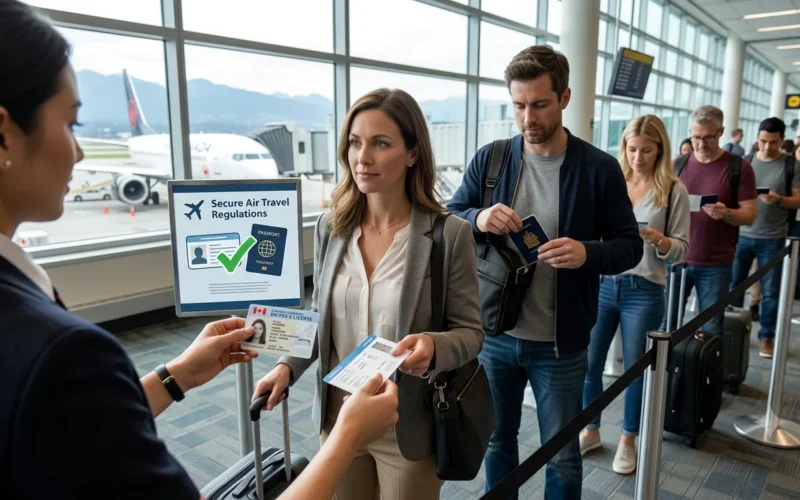
If you are flying between two Canadian destinations, you do not normally need a passport.
For most adults, the standard requirement is either one valid Canadian government-issued photo ID showing your full name and date of birth, or two valid pieces of Canadian government-issued ID, both showing your name and at least one showing your full name and date of birth.
There is an important detail many travellers miss: under the Secure Air Travel Regulations, the mandatory identity check applies at the boarding gate to passengers who appear to be 18 years of age or older. It is based on how old the passenger appears, not simply the age they state.
Foreign visitors and temporary residents can also take domestic Canadian flights without holding Canadian photo identification. Different accepted travel documents apply, including foreign passports and certain U.S. documents.
What ID Do You Need to Fly Within Canada?
For a domestic Canadian flight, passengers who appear to be 18 or older generally have three routes to satisfying the identification requirement.
| Situation | What You Can Present |
| You have Canadian photo ID | One valid federal, provincial or territorial government-issued photo ID showing your full name and date of birth |
| You do not have suitable Canadian photo ID | Two valid Canadian government-issued IDs showing your name, with at least one showing your full name and date of birth |
| You do not have Canadian-issued ID | An accepted foreign travel document, such as a valid foreign passport, NEXUS card, U.S. Permanent Resident Card or U.S. Enhanced Driver’s License |
| Passenger appears under 18 | Federal boarding-gate ID is normally not mandatory, although individual airline rules can apply to infants and unaccompanied minors |
Identification must be valid and not expired, and the name must correspond with the name used for the airline reservation and boarding pass.
Which Government-Issued IDs Are Accepted for Domestic Flights?
Public Safety Canada provides a much broader list than just passports and driver’s licences.
Examples of Canadian government-issued identification that may qualify include:
- Canadian passport
- NEXUS card
- Citizenship card
- Canadian permanent resident card
- Provincial or territorial driver’s licence
- Provincial or territorial health card
- Provincial or territorial identification card
- Birth certificate
- Record of Landing or Confirmation of Permanent Residence, including IMM 5292 and IMM 5688
- Immigration documents issued to foreign nationals, including work permits, study permits, visitor records, temporary resident permits and refugee approved status documents
- Canadian military identification
- Certificate of Indian Status, commonly called a Status Card
- Federal police identification
- Federal or provincial government employee identification cards
- Old Age Security identification card
- Firearms licence
A valid Restricted Area Identity Card is also specifically recognized under the Secure Air Travel Regulations.
Not every document in that list automatically works by itself. To use one document under the one-piece rule, it must contain the required photograph, full name and date of birth.
Documents without all of those details may instead form part of the two-piece identification option.For permanent residents, a valid Canadian PR card is one of the most straightforward forms of government photo identification.
Travellers dealing with an expired, lost or replacement card can also check how a Canadian permanent resident card works and how replacement applications are handled.
Are Hunting, Fishing or Boating Licences Accepted?
No. Hunting, fishing and boating licences cannot be used as identification for domestic air travel in Canada, even though they may have been issued by a government authority.
This exclusion appears directly in the current federal identification rules and the Secure Air Travel Regulations.
What If You Do Not Have Photo ID?
A passport or driver’s licence is not your only option.
If you do not have an acceptable Canadian government-issued photo ID, you can use two valid pieces of identification issued by a Canadian federal, provincial or territorial government.
Both documents must show your name, and at least one must show your full name and date of birth.
For example, depending on the information displayed on the documents, a birth certificate, non-photo health card, immigration document or other government-issued document may form part of the two-piece combination.
Airlines such as WestJet and Flair state that photocopies or pictures of adult identification are not accepted for their normal domestic boarding process.
What ID Do Non-Canadians Need to Fly Within Canada?
You do not have to be a Canadian citizen or permanent resident to satisfy Canada’s domestic-flight identification rules.
If you are a visitor, international student, temporary worker or other foreign national and do not have Canadian-issued identification, the Government of Canada allows certain travel documents to be used.
Accepted options include a valid passport issued by your country of citizenship or nationality, NEXUS card, U.S. Permanent Resident Card, or Enhanced Driver’s License issued in the United States.
Certain travel documents recognized under subsections 50(1) and 52(1) of the Immigration and Refugee Protection Regulations can also qualify.
Foreign nationals who have Canadian-issued immigration documents may also be able to use documents such as work permits, study permits, visitor records or temporary resident permits as part of the Canadian identification rules, provided the documents meet the required identification criteria.
This means an international student flying from Toronto to Calgary, for example, does not need to obtain a Canadian driver’s licence purely to take the domestic flight. A valid foreign passport is an accepted option.
Does Your ID Get Checked at Check-In or at the Boarding Gate?
There is a useful distinction between airline check-in requirements and the mandatory boarding-gate identity verification.
Air Canada, for example, states that valid government-issued identification containing information such as the passenger’s name, date of birth and gender may be requested during check-in.
At the boarding gate, however, the domestic identification rule focuses on the passenger’s full name and date of birth, along with the photograph where photo identification is being used.
Under federal rules, domestic boarding-gate identification no longer has to contain or match a gender indicator.
That is why an airline booking or check-in system may still request gender information even though a gender marker is not required on the ID used for domestic boarding-gate verification.
International travel is different. Government guidance requires international identification to include a photograph, full name, date of birth and gender.
What If the Name on Your ID Does Not Match Your Ticket?
The safest approach is to book your flight using the legal name shown on the identification you intend to present.
Federal regulations require airlines to compare the name on your boarding pass with your identification. A significant discrepancy can trigger additional verification.
Marriage and legal name changes create an important exception in practice.
WestJet states that when two pieces of identification contain different surnames because of a name change, the passenger must present a marriage certificate or legal name-change certificate to establish the connection between the names.
Flair publishes similar guidance.If your documents still show different names following marriage, having your official marriage certificate in Canada available can therefore be particularly important.
However, a marriage certificate should not be treated as a substitute for correcting an incorrectly booked airline ticket. If the name on the reservation itself does not correspond with your travel ID, contact the airline before travelling.
Why Can an Airline Deny Boarding Because of ID?
Identification checks involve more than simply seeing whether you have a card in your wallet.
Current regulations require airlines to compare the passenger’s name with the boarding pass and, when photo identification is used, compare the passenger’s entire face with the photograph.
Air Canada states that carriage can be refused if a passenger refuses to present appropriate valid identification, refuses to show their entire face or does not resemble the photograph on the travel document.
WestJet similarly says boarding may be refused where the passenger does not resemble the ID photograph, the boarding-pass name does not match, the ID is expired or there are inconsistencies between multiple pieces of identification.
The regulations also prohibit an airline from transporting a passenger where photo ID is presented but the passenger does not resemble the photograph, subject to narrow medical exceptions, or where there is a significant discrepancy between multiple pieces of identification.
What Happens If Your ID Is Lost or Stolen Before the Flight?
Losing your wallet immediately before a flight does not automatically mean you cannot travel, but there is no guarantee that alternative identification will be accepted.
Subsection 3(2) of the Secure Air Travel Regulations provides a specific lost-or-stolen-ID procedure.
Where normal identification cannot be produced because it was lost or stolen, an airline may verify identity using other valid documents, such as an employee identification card, public transit pass or baptismal certificate, when those documents are presented together with documentation from a government authority or police service confirming the loss or theft.
The word “may” matters. This is an alternative verification process rather than an automatic right to board.
If your ID is lost or stolen, contact the airline as soon as possible, obtain police or government documentation of the loss where possible, gather any remaining identification you have and allow extra time at the airport.
A photo of your driver’s licence stored on your phone is useful for your own records, but it does not replace the identification required under the normal domestic boarding rules.
What ID Do Children Need to Fly Within Canada?
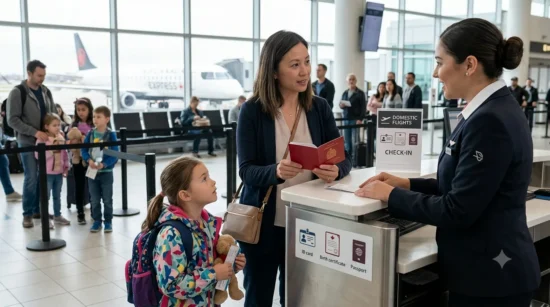
Federal boarding-gate identification rules apply to passengers who appear to be 18 years of age or older. This means children travelling domestically do not ordinarily have to present the same adult government ID.
Airlines can still impose additional requirements for specific circumstances.
Air Canada suggests that travellers younger than 18 carry an original birth certificate or another form of identification, although it is normally not mandatory unless its Unaccompanied Minor Service is being used.
WestJet’s requirements are more detailed. Children must travel with an adult until they turn 12 unless they use the airline’s unaccompanied-minor service.
WestJet recommends government-issued identification for children and requires proof of age for infants under two.
For a child using WestJet’s unaccompanied-minor service, a photocopy rather than the original of the child’s government-issued ID showing the child’s name, gender and date of birth must travel with the child.
The adults responsible for both dropping off and collecting the child must also present valid government-issued identification.
These child-specific requirements are airline policies, so parents should always check the carrier operating the flight rather than assuming every airline follows identical procedures.
Can You Use Air Canada’s Digital ID Instead of Showing Physical ID?
Air Canada currently offers an optional digital identification system through its mobile app for eligible travellers on select domestic flights departing from Toronto Pearson International Airport (YYZ) and Vancouver International Airport (YVR).
The service uses facial recognition. Eligible adults create a digital profile by scanning the chip in an electronic passport and taking a selfie.
At participating airport checkpoints, facial recognition can then verify the traveller without requiring them to physically present their boarding pass or government ID at that specific touchpoint.
This should be described as a current 2026 feature, rather than a new program launched in 2026. Air Canada originally introduced its digital-identification pilot in 2023 and has expanded its availability since then.
Digital ID is voluntary, available only at participating locations and does not eliminate the underlying legal identification requirements.
Travellers should still carry acceptable physical identification in case normal document verification becomes necessary.
What Is a Canadian Travel Number?
A Canadian Travel Number, or CTN, is a unique number issued through Public Safety Canada’s Passenger Protect Program.
It is designed for travellers who experience repeated airline check-in problems because their name is the same as, or similar to, someone on the Secure Air Travel Act list, sometimes referred to as Canada’s “No Fly List.”
A CTN can be supplied when making a reservation or added to eligible bookings so centralized screening has another piece of information available to distinguish the traveller from someone on the SATA list.
A Canadian Travel Number is not mandatory, and it does not replace your passport, driver’s licence or other required travel ID.
It also does not solve unrelated problems such as an expired passport, invalid identification, immigration issues, flight cancellations or ordinary airport security delays.
Travellers who repeatedly encounter what appears to be a false name match can review Public Safety Canada’s Canadian Travel Number information.
Air Canada vs WestJet vs Flair vs Porter: Domestic ID Rules
The basic requirement is similar across Canadian carriers because it comes from federal regulation, but individual airlines provide slightly different operational guidance.
| Airline | Main Domestic ID Rule | Useful Airline-Specific Detail |
| Air Canada | One valid Canadian photo ID or two valid Canadian non-photo IDs; accepted foreign alternatives are also listed | Explicitly checks passengers who appear 18+; passenger must resemble photo; refusal to show full face can result in refusal of carriage; optional digital ID at select YYZ/YVR domestic flights |
| WestJet | One valid Canadian photo ID, two valid Canadian non-photo IDs or specified foreign alternatives | Adult IDs must be originals; marriage/name-change certificates can bridge changed surnames; detailed unaccompanied-minor identification rules |
| Flair Airlines | One Canadian government photo ID or two qualifying Canadian IDs; accepted foreign alternatives available | First and last name must match reservation; middle-name discrepancies are generally acceptable; marriage/name-change documentation recognised |
| Porter Airlines | One Canadian government photo ID or two Canadian government IDs for travellers who appear 18+ | Non-Canadian travellers can use documents used to enter Canada; ID for under-18 domestic travellers is generally requested rather than mandatory, except certain infant and unaccompanied-minor situations |
Do You Need a Passport to Fly Within Canada?
No. A Canadian passport is not mandatory simply because you are taking an aeroplane between two Canadian locations.
A Canadian citizen flying from Toronto to Vancouver, Calgary to Montreal or Halifax to Ottawa can normally use a valid provincial driver’s licence or other qualifying Canadian government photo ID.
A passport is nevertheless useful because it meets the one-piece identification requirement when valid.
Foreign visitors can also use their valid foreign passport for domestic Canadian flights.
The rules change if any part of the itinerary crosses an international border.
International travel has different identification and entry requirements, so a document acceptable for a purely domestic flight should not automatically be assumed to be sufficient for an international connection.
What Should You Check Before Going to the Airport?
Before a domestic Canadian flight, confirm that the identification you plan to use is valid, has not expired, contains the information required for the one-piece or two-piece option, and corresponds with the name on your reservation.
If your surname recently changed, deal with the booking and supporting marriage or legal-name-change documentation before departure.
Foreign visitors should keep the passport or other qualifying travel document they used to enter Canada readily available.
Parents should separately check their airline’s requirements for infants, young travellers and unaccompanied minors.
Most importantly, do not rely on fishing, hunting or boating licences, screenshots of identification or ordinary photocopies for an adult’s standard domestic ID verification.
Frequently Asked Questions
Can I use my driver’s licence to fly within Canada?
Yes. A valid Canadian provincial or territorial driver’s licence containing your photograph, full name and date of birth normally satisfies the one-piece domestic ID requirement.
Can I fly within Canada without a passport?
Yes. A passport is not mandatory for a purely domestic Canadian flight. A qualifying Canadian government photo ID or two qualifying Canadian government IDs can be used instead.
Can I use a NEXUS card to fly within Canada?
Yes. NEXUS is specifically listed as an accepted form of identification for domestic Canadian air travel.
What ID does a foreign visitor need for a domestic Canadian flight?
A foreign visitor without Canadian ID can use a valid foreign passport, NEXUS card, U.S. Permanent Resident Card, U.S. Enhanced Driver’s License or certain other recognized travel documents.
What is a Canadian Travel Number and do I need one?
A CTN helps travellers whose names resemble someone on the Secure Air Travel Act list avoid false-match delays. It is optional and does not replace ordinary travel identification.
What if my ID name does not match because I got married?
Contact the airline before travelling. WestJet and Flair specifically allow a marriage certificate or legal name-change certificate to establish the connection where surnames on two pieces of ID differ because of a name change.
Can I use an expired passport as domestic flight ID?
No. Identification presented for domestic air travel must be valid and unexpired.






Comments 1